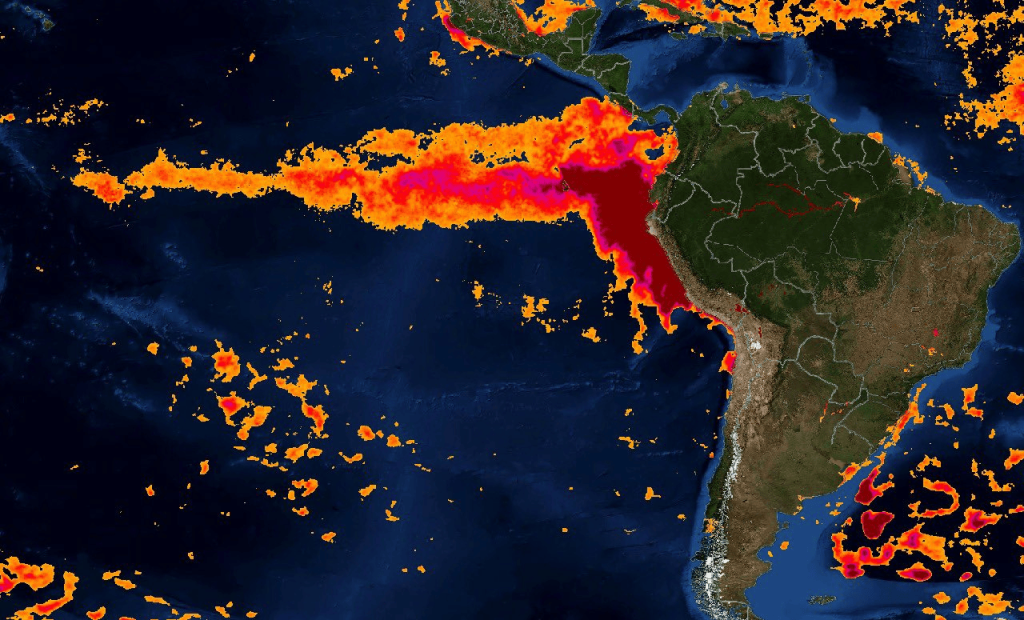
Although it's best to wait a few months to confirm that the environmental events that have plagued and continue to plague the country are due to climate change, common sense suggests a positive correlation between the global temperature increase and the factors that trigger the increasingly frequent El Niño phenomenon. Therefore, a national priority should be preparing to face this phenomenon and its consequences almost permanently.
For Peru, climate change must be a priority. It's not just about restoring infrastructure or building new infrastructure to help minimize its adverse effects, but primarily about understanding it. To do this, we need scientific research, and to take action, we need innovation.
The Minister of Economy told Congress that the losses from Cyclone Yaku and the approaching El Niño phenomenon could reach USD 2.6 billion, slightly more than 11% of our GDP. 11% is a key figure for those involved in Science, Technology, and Innovation (STI); it represents the percentage of research and development spending relative to GDP that we aspire to in order to catch up with Brazil, the country that invests the most in Latin America, and which would place us at just over a third of the spending of OECD countries. But beyond comparing ourselves to other countries, it would help us understand and take action regarding these events to minimize losses, especially human losses.

Many countries are adopting a mission-based science, technology, and innovation (STI) policy, which ensures that all actors involved in its implementation share a common goal—a national priority. This encompasses nearly all sectors, including the economy, housing, transportation and communications, agriculture, and production, among others, as well as all three levels of government, which will need to coordinate and align their actions to achieve effective reconstruction. It also involves the academic sector and, most importantly, businesses, which will need to become the primary implementers of the solutions developed.
Establishing a mission-driven science, technology, and innovation (STI) policy doesn't mean ceasing funding for other areas, but it does help focus the results. Climate change concerns not only meteorological sciences, but also biology, geology, engineering, mathematical modeling, medicine, and so on. And if we want to learn from the past, as we should try to do, we need to draw on archaeology and history; this would give us an excellent opportunity to incorporate modern elements to enhance the solutions implemented in the past. But it also involves the social sciences because ultimately we have to understand the rationale of people who make seemingly senseless decisions, such as settling in ravine areas, which, as we have just seen, occurs not only among vulnerable population groups but also among those who have made significant investments within the formal economy.
However, the most important thing is innovation because climate change requires implementing solutions of all kinds. These include science-based solutions, but also social ones, often based on common sense, or adapting solutions that have worked in other regions. And we also need change agents, those entrepreneurs who can perceive the new needs that climate change brings and create products and services that can meet and scale them.
The 1% GDP loss can help us recover what we've lost, but it can also be the stimulus our society needs to transform catastrophic events into opportunities for development. Hopefully, in 20 years, when we look back, we won't add these events to our list of missed opportunities.