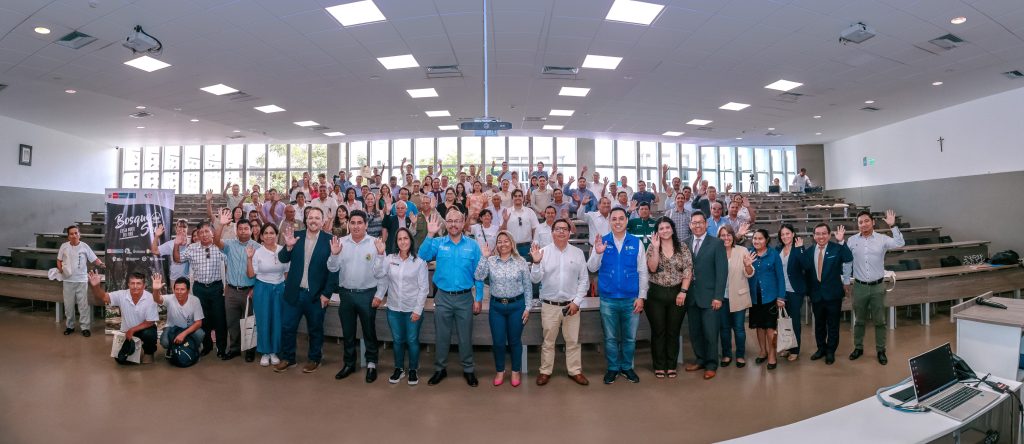
Piura, December 2023. To strengthen the resilience of rural communities in northern Peru to climate change, the "Dry Forest of the North Coast of Peru" project was launched. This initiative aims to restore and sustainably manage the dry forests of the northern coast of Peru, in the regions of Piura, Tumbes, Lambayeque, and La Libertad. While these ecosystems are fundamental for mitigating the effects of climate change, dry forests are also threatened by human activities, which to date have degraded 951,000 tons of this ecosystem in Peru.
The initiative is led by the Ministry of the Environment (MINAM) and will be implemented over a four-year period, with support from the Ministry of Agrarian Development and Irrigation and funding from the Global Environment Facility (GEF). It has the backing of implementing agencies such as the Food and Agriculture Organization of the United Nations (FAO) and the International Union for Conservation of Nature (IUCN). Profonanpe, Peru's environmental fund, acts as an operational partner for the project, thus contributing to strengthening the connectivity and resilience of dry forests.
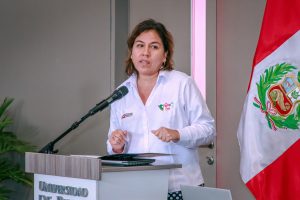
Mariela Cánepa, Vice Minister of Strategic Development of Natural Resources of the Ministry of the Environment.
“We want to continue many of the activities and objectives of projects related to carob tree conservation developed in the north of the country, as well as complement the management of the regional governments involved in the dry forest. Taking a landscape and connectivity perspective will allow us to conserve the biodiversity of this particular forest, which offers a wealth of biodiversity,” highlighted Mariela Cánepa, Vice Minister of Strategic Development of Natural Resources at the Ministry of the Environment.

Enrique Román, assistant representative of the FAO in Peru.
Enrique Román, FAO Assistant Representative in Peru and leader of the project's implementing agencies, emphasized: “Over the past 35 years, the regions of Piura, La Libertad, Lambayeque, and Tumbes have experienced a loss of more than 298,000 hectares of dry forest, all due to deforestation. Today, through this project, we are joining the effort to combat threats such as deforestation and land degradation. We cannot underestimate the importance of this ecosystem, as it harbors a large number of native species crucial to biodiversity.”
The Dry Forest project is being announced in a context where the climate crisis is significantly impacting northern Peru. It is estimated that, in 2024, the impacts of El Niño will increase river flows on the northern coast, surpassing unprecedented levels and affecting agricultural production and, consequently, the economic livelihoods of rural communities in this region of the country.

Omar Corilloclla, Director of Monitoring and Evaluation at Profonanpe.
“Globally, we are in the midst of a climate crisis, the consequences of which are increasing every day, and therefore it is urgent”We need swift action from all sectors. Efforts to mitigate and adapt to climate change are not enough; therefore, we are very optimistic to take on the challenge of announcing this project to conserve and restore the biodiversity of the dry forests on the northern coast of Peru. This is a key action for the national environmental agenda,” highlighted Omar Corilloclla, Director of Monitoring and Evaluation at Profonanpe.
“Dry Forests of the North Coast of Peru” has a total budget of USD 65,500,012.42, distributed between the donation from the GEF (USD 7,666,491.00) and the contribution of various national and international entities as counterpart funding (USD 57,833,521.42); it will have a direct, focused intervention area divided into six (6) large corridors that include the presence of Regional Conservation Areas (ACR), managed by the Regional Governments of Piura, Tumbes, Lambayeque and La Libertad; and Protected Natural Areas managed by SERNANP, key actors for the project.
Similarly, it will be executed through four interrelated components:
- Governance with a multi-sectoral, multi-level and multi-actor approach for sustainable development.
- Ecological connectivity of dry forests and restoration through effective management and financial sustainability of conservation areas and buffer zones.
- Sustainable production practices for the conservation of natural heritage.
- Knowledge management, monitoring and evaluation.
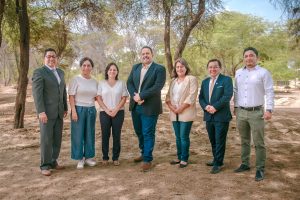 Technical team of the “Dry Forest of the North Coast of Peru” project. From right to left: Vladimir Saguma, coordinator of Governance with a Multisectoral Approach; Margarita Huamán, specialist in Safeguards and Gender; María del Carmen Vargas, coordinator of Knowledge Management, Monitoring and Evaluation; Sergio Lazo, coordinator of the Dry Forest project; Patricia Medina, coordinator of Ecological Connectivity and Restoration; Walter Ruiz, coordinator of Sustainable Production Practices; Russel Flórez, administrative technical assistant.
“The dry forest of Peru’s northern coast plays a crucial role in climate change adaptation and mitigation and is home to diverse biodiversity. It is also essential for 2.6 million inhabitants, the vast majority of whom live in poverty and depend on this ecosystem as their primary source of income. We have identified 190,000 inhabitants engaged in agriculture, small-scale agro-industry, and ecotourism. However, the dry forests are subjected to anthropogenic pressure, resulting in the loss of their biodiversity and land degradation,” highlighted Sergio Lazo, Technical Coordinator of the project.
During the meeting, the next steps in the initial implementation phase were also highlighted. It is worth noting that the preliminary Annual Operating Plan (AOP) for January through March 2024 was approved at a meeting of the Project Steering Committee held prior to the event. The Project Steering Committee Council is comprised of representatives from the Ministries of Environment and Agriculture, implementing agencies, regional governments, and key partners.
For more information, visit the project website. here.