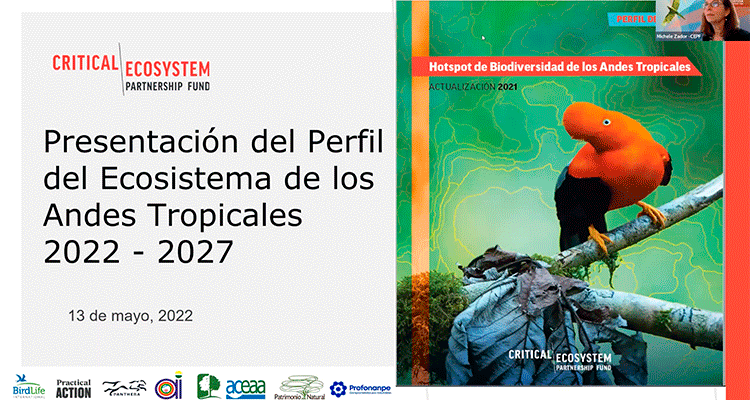
Last Friday, May 13th, the Critical Ecosystem Partnership Fund (CEPF), presented the Ecosystem Profile of the Tropical Andes Hotspot, a document produced thanks to an alliance of five NGOs and twelve Andean experts on topics such as conservation biology, environmental policies, civil society, investment in conservation, threats to biodiversity, socioeconomics and species.
This is a diagnosis of this region of the planet up to 2021, which allows us to identify the results obtained in conservation, and evaluate the political, socioeconomic and scientific context that surrounds it. hotspot and, at the same time, present an investment strategy for the CEPF in the area.
Claudia Vega, from Pronature, He explained that there were two other processes that were carried out simultaneously with the development of the profile: the “Long-term vision for the Tropical Andes”,“ implemented by Talking Transformation, and ”Strategic Planning in Ecuador,“ conducted by KfW and the Ecociencia Foundation. Vega highlighted the former because it ”sought to update criteria and goals for CEPF investment.”.
Olivier Langrand, CEO of CEPF, stated that the“Ecosystem Profile offers a roadmap to help CEPF to better channel its financing in the Tropical Andes Hotspot”"And, despite the challenges facing the region, he expressed optimism about the great opportunities that this and other similar documents can open up in biodiversity conservation actions.".
Michael De La Cadena, CEO of Pronature, the organization that led the process of updating the Ecosystem Profile, He emphasized that the work was "intense and enriching for everyone," but also that it was a source of pride to have achieved the goals and expectations, despite adverse circumstances such as the COVID-19 pandemic.
A wealth of discoveries
In his diagnosis to Tropical Andes Hotspot, he Ecosystem Profile It confirms that it is an invaluable region for humanity. It is home to more than 35,000 species (half of them endemic), covers more than 158 million hectares (three times the area of Spain), and has the second largest irretrievable carbon reserve of the world's 36 hotspots, but it also faces serious threats.
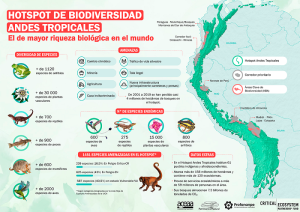
General infographic revealing the most important findings of the Tropical Andes Hotspot Ecosystem Profile. Credits: Jazmín Ceras
He explained it this way Rafael Antelo, The technical director of the team that led the profile update commented that its carbon reserve is so vital that, if lost, the goal set during the Paris Agreement could not be achieved. And the statistics tell us that there is still much to be done in the Tropical Andes.
While Colombia, Ecuador, and northern and central Peru are the most vulnerable areas in terms of threats, the entire hotspot requires conservation actions such as those funded by the CEPF, To cite just one example, between 2001 and 2019, it suffered the deforestation of 3.9 million hectares. The Profile also revealed that 173 of its 474 KBAs are currently unprotected.
Despite the adverse circumstances, Alfredo López, of the Arcoiris Ecological Foundation, He highlighted that there is an increasingly “more robust institutional framework,” which has allowed civil society organizations (CSOs) to demand greater participation and a more prominent role in the preservation of areas such as the Tropical Andes Hotspot. For example, in updating this profile, 268 stakeholders from 103 CSOs were involved.
Michele Zador, portfolio director of CEPF for the Tropical Andes Hotspot, He highlighted the participation of the organizations in the preparation of the document, but also recognized the high quality of the conservation projects that have been carried out in the Tropical Andes Hotspot and that have allowed a Phase III of investment to be developed, which will take place between 2022 and 2027.
“It was very gratifying that an Ecuadorian organization, which is not from the capital, was able to be part of this profile update process,” he noted. Arturo Jiménez, president of the Arcoiris Ecological Foundation, who highlighted that the challenge of preparing this document has been taken on by local organizations in the countries involved.
Furthermore, he invited local and social organizations working alongside the prioritized KBAs, and which have linked their problems with the investments and opportunities offered by the CEPF, they can consider this profile “as a guide to truly develop and strengthen their management”.
The webinar also included the participation of the coordinators of the Regional Implementation Team (RIT) for Phase III of CEPF investment in our hotspot: Cynthia Garland, from Profonanpe (Peru); Martha Silva, from the Natural Heritage Fund (Colombia) and Jorge Mariaca, from ACEAA (Bolivia).