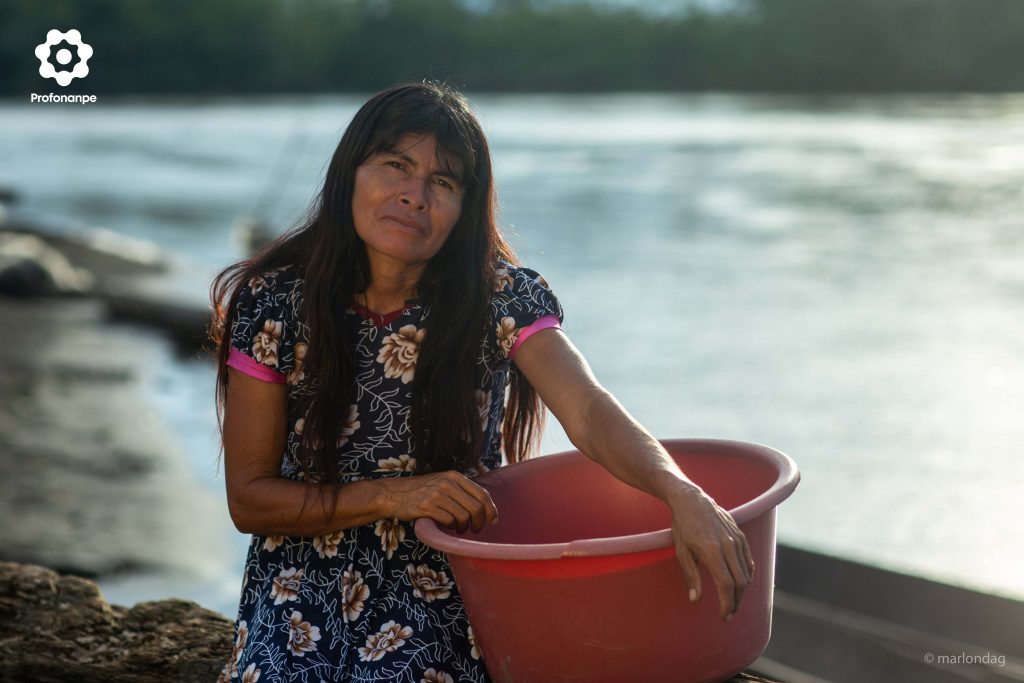
September, 2021. – Demonstrating their ability to overcome difficult circumstances, the Charapi Women's Association, located in the Kandozi community of Musa Karusha - Datem del Marañón province - led by Balbina Sundi Akumbari; has been working on the collection, conservation and repopulation of taricaya turtle eggs with the support of Profonanpe, the environmental fund of Peru, through the Datem Wetlands Project.
In 2004, Balbina started this work voluntarily for environmental purposes and, today, having become a bio-business, she has managed to involve about twenty women from the Kandozi village, who earn income from the eggs and the sale of baby turtles to support fuel, food and their supplies.
«"The project is necessary for the widows, the orphans... If the turtles disappear, what will these women do for work?" Balbina, 50, told Efe.
Despite the unfavorable circumstances, with this bio-business, Balbina is a role model for other women in her village, as she is the first woman to lead an association in this area of the Peruvian jungle, where historically they have played a role with little prominence.

Repopulate taricayas
The work involves collecting taricaya turtle eggs from the shores of Lake Rimachi, located just a few minutes by river from the community of Musa Karusha. They then transport the eggs to the 20 artificial beaches they have built at their camp, plant them, and care for the nests, which incubate for about 70 days, the estimated time it takes for the turtles to hatch. Once they emerge, half are sold to formal traders in the city of Iquitos, who export the animals mainly to Asia, while the other half are returned to the lake to promote the repopulation and conservation of this aquatic turtle.
Maintaining a balance between the use and preservation of these reptiles is key for this turtle species, one of the largest in the Amazon basin and classified as vulnerable by the International Union for Conservation of Nature. Uncontrolled human consumption is the greatest threat to this animal, highly valued for both its meat and eggs.
«"If we sell everything, the taricaya turtles will disappear," said Balbina, who added that, beyond the commercialization of the turtles, her association also profits from the sale of "non-viable" eggs, that is, those that are not suitable for planting, but are consumed as food in the area.
The Datem Wetlands Project seeks to improve the resilience capacities of indigenous communities living in wetland ecosystems rich in carbon reserves in the Datem del Marañón province, Loreto; as well as improve their livelihoods and reduce greenhouse gas emissions caused by deforestation.
With information from EFE