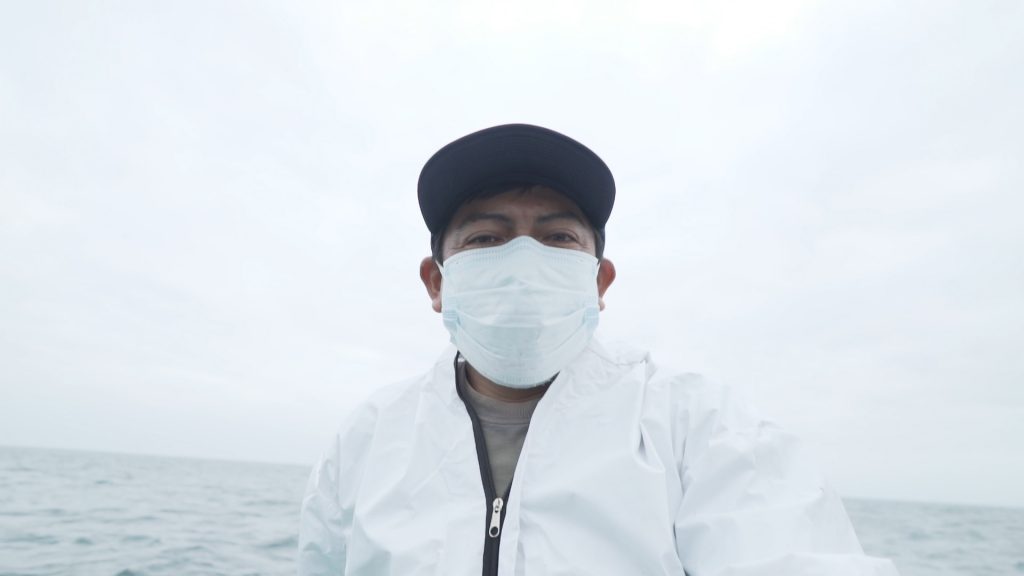
June 2021. – Every day at 3 a.m., Don Ubaldo (42) takes the hook he wound the night before, his fish, and leaves his house in the El Alto fishing district of Piura, heading for the Cabo Blanco pier. Before leaving, he kisses his five-year-old son on the forehead and stops in the middle of his living room to cross himself before the altar of his father, who passed away in February of this year. Don Ubaldo recounts that by the age of eight, he was already demanding that his father take him out to sea: to embark on the open ocean to fish for bonito, hake, grouper, and tuna—species that abound in what he calls "the blessed waters of the sea off Cabo Blanco in Piura.".
He studied metalworking in Piura and worked in the oil industry throughout his life, but his passion for fishing—inherited from his father and grandfather—brought him back to his hometown. At 38, he got engaged to his now-wife, and they had a young son who now also asks him to take him fishing in the early mornings. "He wants me to wake him up early to come with me, but I feel bad; he's still very little and has to study the next morning," he says. However, he knows that the time will come for him to learn the family tradition.

“My son is very young; I would expose him to the cold and high temperatures. Likewise, I feel a great responsibility to teach him this work because it will serve him in his future, just as it has served me. I have worked at so many things, but fishing never said no to me; it has given me everything, and I am still here thanks to it,” says Don Ubaldo.
After more than eight hours at sea, over ten miles from the village, he returns in his boat, "Mi Salvador," which has been with him since 2016, with up to 200 kilos of fish. "Before, you could find fish close by, but because of climate change, you have to go much farther out," he says with a touch of nostalgia.
“Climate change is having a major impact, and besides having to travel farther to find species, their numbers are decreasing. Much of this is related to oil spills, garbage, and pollution from cities that discharge into the sea. I urge us to become more aware of the need to throw away less garbage to protect the sea, the source of life for many of us,” he emphasizes.
Climate change caused by human activity, specifically the intensive use of fuels like coal, oil, gasoline, and other petroleum-derived fuels, has created a significant problem in Peru's coastal marine zone, according to the Ministry of the Environment. One of the major impacts on the sea is the sudden shift in ocean circulation, causing significant changes in the distribution and migration patterns of marine species. This leads to reproductive failures and, consequently, a slight scarcity that forces fishermen, like Don Ubaldo, to risk their lives even more to bring in the fish we eat at home.
At the Cabo Blanco pier, more than 600 fishermen follow a similar routine, and Don Ubaldo is one of the beneficiaries of the "Adaptation to the Impacts of Climate Change on the Coastal Marine Ecosystem" project by Profonanpe, the Environmental Fund of Peru. Profonanpe works in conjunction with the Ministry of the Environment, SERNANP (National Service of Natural Protected Areas), the Ministry of Production, and with funding from the Adaptation Fund to build resilience in communities against the impacts of climate change. Through this project, Don Ubaldo receives training to improve his fishing techniques and, recently, has been part of the pilot Monitoring System. A camera was installed on the upper deck of his boat to record, step by step, the moment of catching fish at sea, while adhering to all marine ecosystem protection protocols.
This new Monitoring System, which has yielded good results in Chile, allows the generation of a QR code that consumers can scan when purchasing their fish and observe the entire process that their product went through before reaching their table.
“I am grateful to be part of this project because it allows me to add value to my product so that the consumer feels happy to see where it comes from and is happy to see that they are consuming a healthy fish, extracted in the best way, taking care of the marine ecosystem,” says Don Ubaldo Tume.
Finally, he reflects with a message to the new generations of fishermen, asking them to work with respect for the sea and its species in order to preserve the production of the entire marine ecosystem and continue bringing this delicious product to the tables of Peruvian families.