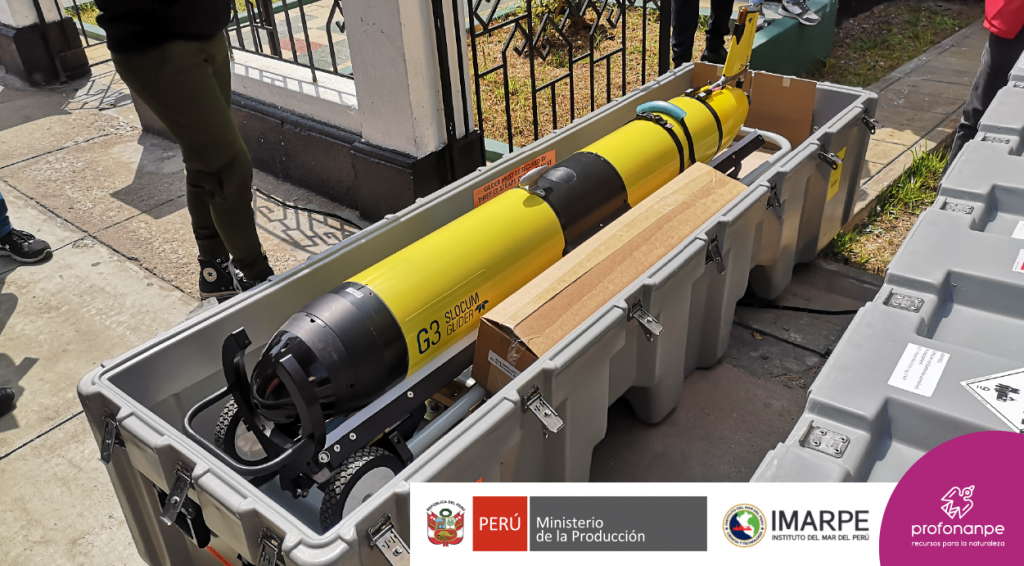
On July 7 they arrived at the offices of IMARPE three autonomous underwater vehicles, also known as Glider. These equipments will allow for automatic and near real-time monitoring in the project areas. Its main objective is to obtain oceanographic information on parameters such as temperature, salinity, oxygen, chlorophyll and other parameters of the sea , up to 1,000 meters deep, and even the oceanic zone of the Peruvian sea.
This information will contribute to the determination of vulnerability scenarios and impacts of climate change on marine-coastal ecosystems and their fishing resources . This will positively impact the overall challenge of the project, which is to increase the resilience of these ecosystems and the coastal communities of artisanal fishermen.
The project “Adaptation to the impacts of Climate Change on the coastal marine ecosystem of Peru and its fisheries” was approved Adaptation Fund, providing the financing for its implementation through Profonanpe. The project's execution is the responsibility of Ministry of Production, in coordination with the Peruvian Marine Institute (IMARPE). This initiative includes technical activities at different levels, focusing its interventions on two pilot areas: Huacho (Punta Salinas – Végueta) and Máncora (Cabo Blanco), representative areas of the Peruvian upwelling ecosystem and the transition with the tropical ecosystem, respectively.