He Mountain Institute The Mountain Institute and the Junta de Usuarios de Agua del Sector Hidráulico Menor Medio Alto Santa - Clase A designed a capacity building plan aimed at improving water resource management in the Santa river basin. This plan includes key topics such as governance and leadership, regulatory framework and user rights, climate change and adaptation, technical water management and intercultural facilitation.
The program will be implemented through a cascade training model, which will allow knowledge transfer and capacity building from the board of directors. and the technical team towards the commissions, the committees and, finally, the water users.
The users' boards, as the highest level of water users' organization, made up by 7 commissions, over 500 committees and more than 50 thousand water users,The Santa River Basin Water Management Program, which is part of the Santa river basin, plays a key role in the management of water resources, the administration of irrigation infrastructure and the equitable distribution of water in the Santa river basin. In this context, the process seeks to strengthen water governance, promote its efficient and sustainable use, improve the operation and maintenance capacities of irrigation systems, and incorporate the approach of adaptation to climate change with intercultural and gender relevance, in the face of risks such as droughts, climate variability and glacial retreat.
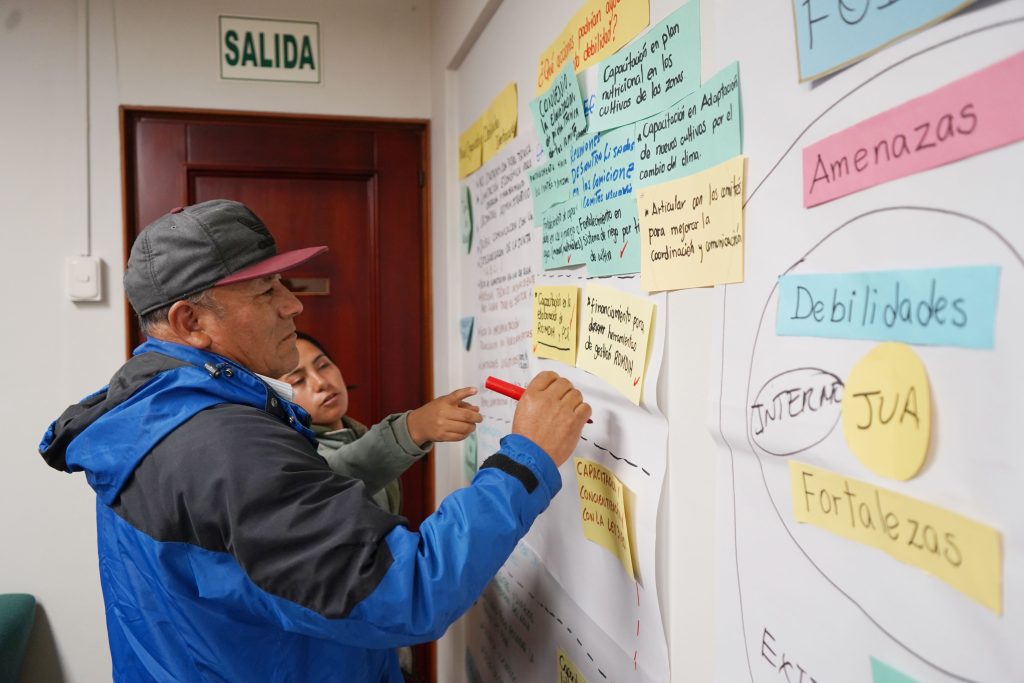
The proposal was based on a participatory assessment carried out during the workshop “Planning for capacity building in water resource management”, organized within the framework of the project. Living Basins. Through a dynamic methodology, members of the board of directors and the technical team identified challenges related to administrative management, coordination with users, leadership and the adoption of irrigation technologies.
The project Living Basins is implemented by Profonanpe, with financing from the Adaptation Fund, and led by Mountain Institute in the Santa river basin, in the Ancash region. Its objective is to strengthen the resilience of communities and ecosystems in the face of climate change, contributing to national adaptation goals.