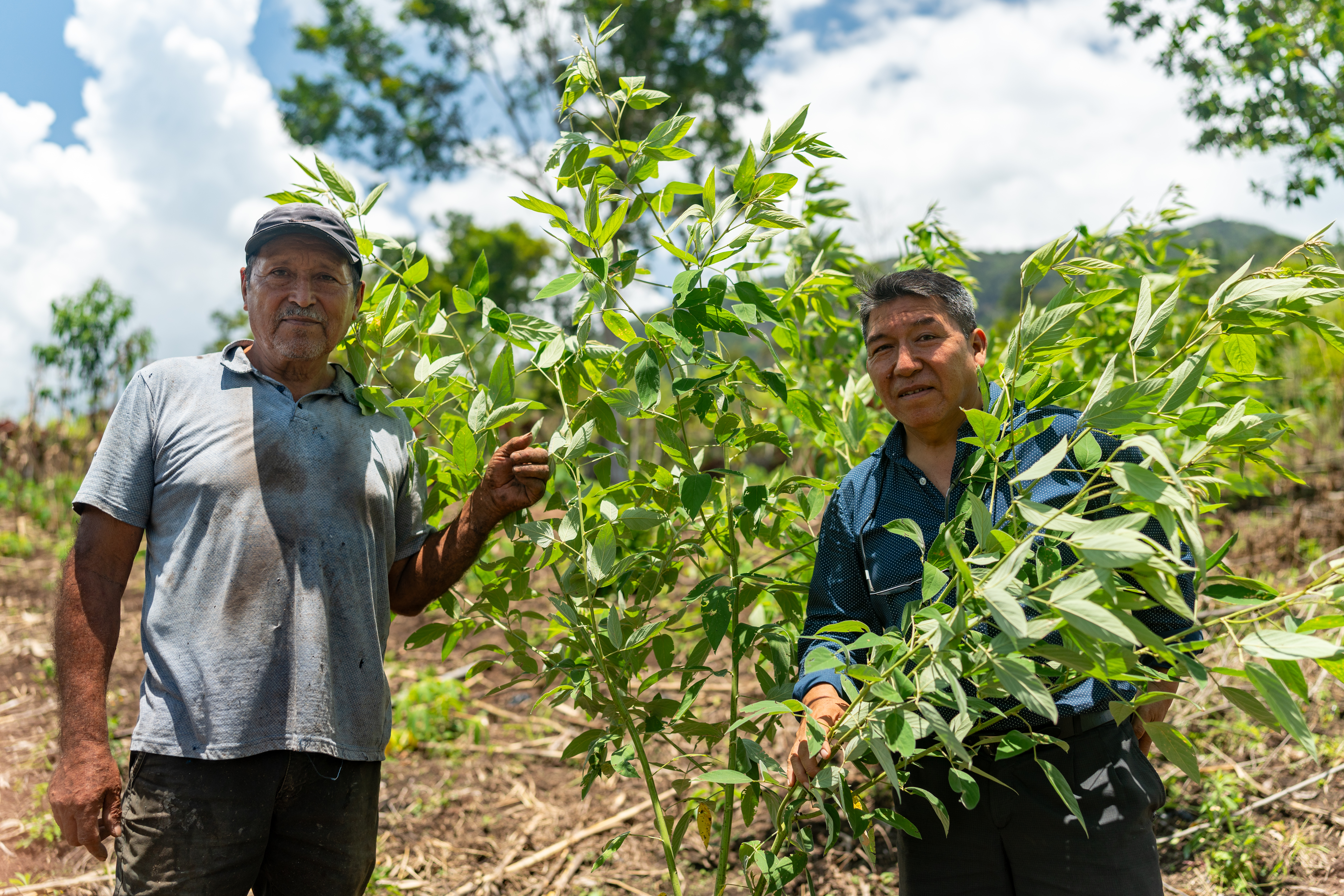
Joel Guerrero Burga, a native of the Agua Azul Chontalí hamlet and inhabitant of San José del Alto in the province of Jaén (Cajamarca), knows better than anyone the diversity and uniqueness of the montane forests. There, where biodiversity coexists with the constant threat of deforestation and migratory agriculture, he decided to forge his own path: to study Forestry and Environmental Engineering with the conviction of contributing to the care of his territory through knowledge and community action.
His vocation was born in the field, first as a volunteer park ranger in the Regional Conservation Area Páramos y Bosques Montanos de Jaén y Tabaconas, a job he did for 2 years. In 2024, he became a control and surveillance monitor for 3 months and today he is a volunteer park ranger in the same RCA. His work is not limited to hiking trails. Between patrolling and installing camera traps, he also promotes the implementation of agroforestry systems with native species such as romerillos (Podocarpus sp.), rehabilitating ecosystems that serve as refuge for birds and wildlife. A silent but essential task to ensure that forests continue to breathe.
Today, their knowledge, effort and commitment are added to the proposal for the establishment of the Huamantanga and Chorro Blanco Montane Forests Regional Conservation Area as a key actor for community and strategic articulation: “Protecting what is left is essential. It's not just about extracting from nature, but learning to live with it,” he says.
People are the main allies of conservation
In districts such as San José del Alto, coffee is the main livelihood for thousands of families. However, the expansion of plots of land to higher elevations (around 2,000 meters above sea level) generates tensions with nature. Faced with this challenge, the proposal of the Huamantanga and Chorro Blanco Montane Forests Regional Conservation Area seeks to articulate communities, associations, municipalities, academia and authorities, with special emphasis on the participation of women, to promote sustainable productive alternatives.
The commitment is clear: without solid governance, no conservation is possible. That is why the project works to build trust, commitment and capacity in leadership, hemispheric conservation, gender and inclusion. Likewise, for Joel, who has been planting trees since he was a child and learned to recognize the richness of his environment, this effort is also a process of constant dialogue with his fellow countrymen. Through workshops with children and youth, he has become a spokesperson for the benefits of protecting the forests.
The challenge of living with nature
The threats to biodiversity are evident: between 2001 and 2023, more than 24,000 hectares of forest were lost in the region, that is, about 1,000 hectares every year. In addition, there has been an increase in and poor prevention of forest fires due to poor institutional coordination and traditional practices such as burning vegetation to attract rainfall, which causes fires and fragments ecosystems.
This context places the montane forests of Huamantanga and Chorro Blanco in a vulnerable state, which are home to endangered species such as the Bearded Guan (Penelope Barbata), the “Seven-colored” or “Blue-breasted” Toucan (Andigena hypoglauca) and the Peruvian Tororoi (Grallaricula peruviana), bioindicators that reveal the health of the ecosystem. In addition, these lush green bodies regulate temperature, store carbon and are headwaters of the Chinchipe, Alto Marañón and Chamaya rivers, vital water sources for more than 116,000 people in Jaén.
As proof of life, in Puerta del Edén, the hamlet where Joel lives, there is the waterfall “La Maravilla del Edén” (The Wonder of Eden), discovered only a decade ago. This space not only feeds the rivers of the region, but also shelters birds and wild flora. For Joel, it is a living reminder of how waterfalls, forests and watersheds sustain life in balance with communities.

Waterfall “The Wonder of Eden”. Photograph: Ángela Montero
Since 2021, actions have been promoted at different levels to make the establishment of the Huamantanga and Chorro Blanco Montane Forests Regional Conservation Area a reality, led by the Regional Government of Cajamarca with the participation of local communities, municipalities, academia, SERNANP and the technical support of Nature and Culture International. Currently, in its fourth stage of establishment, the project is gaining new momentum thanks to the support of the second edition of Conserve Birds, financed by the Government of Canada.
In this process, Joel is a key player: citizen, professional and leader who connects local engagement with regional and international efforts. “There is always a benefit to protecting: we mitigate climate change and ensure water and life for generations to come,” he stresses.
The Conserva Birds Initiative is led by the American Bird Conservancy (ABC), the National Audubon Society (Audubon), BirdLife International, Birds Canada, and the Latin American and Caribbean Environmental Funds Network (RedLAC). The national partners are Profonanpe and ECOAN, which are leading the implementation in Peru, with funding from the Government of Canada.