The Tamshiyacu Tahuayo Communal Regional Conservation Area (ACR) in Loreto is making steady progress in the protection of its forests and the promotion of sustainable activities, thanks to the joint work of the State, local communities and the support from the Joint Statement of Intent (JIU) Financial Mechanism.
During the technical visit on August 21, authorities from the Ministry of the Environment (Minam), the National Service of Natural Areas Protected by the State (Sernanp), the Regional Government of Loreto, the Norwegian Embassy and Profonanpe, verified in the field the advances in effective management, community surveillance and sustainable economic development in this area that houses more than 420,000 hectares of Amazonian forests.
During the visit, the Vice-Minister of Strategic Development of Natural Resources of Minam, Raquel Soto, highlighted the articulated work for the management of the area. “This visit not only represents a symbolic gesture, but the recognition of an effective management built in a collaborative manner between the Regional Government, the head of the area, the organized communities and international cooperation,” she said.
The DCI works with four RCAs in the Loreto region: Ampiyacu Apayacu, Maijuna Kichwa, Alto Nanay and Tamshiyacu Tahuayo, where more than 2.2 million hectares are expected to be managed this year. By mid-2025, the progress is more than 970,000 hectares patrolled and monitored.
Along these lines, Profonanpe's Executive Director, Anton Willems, highlighted the work carried out in the RCA. “From Profonananpe we make the work led by the Ministry of the Environment and accompanied by international cooperation move from paper to direct work with the communities. This would not be possible without the articulated work and the sustainability policy led by the state and implemented in the territory by the regional government and the communities,” he said.
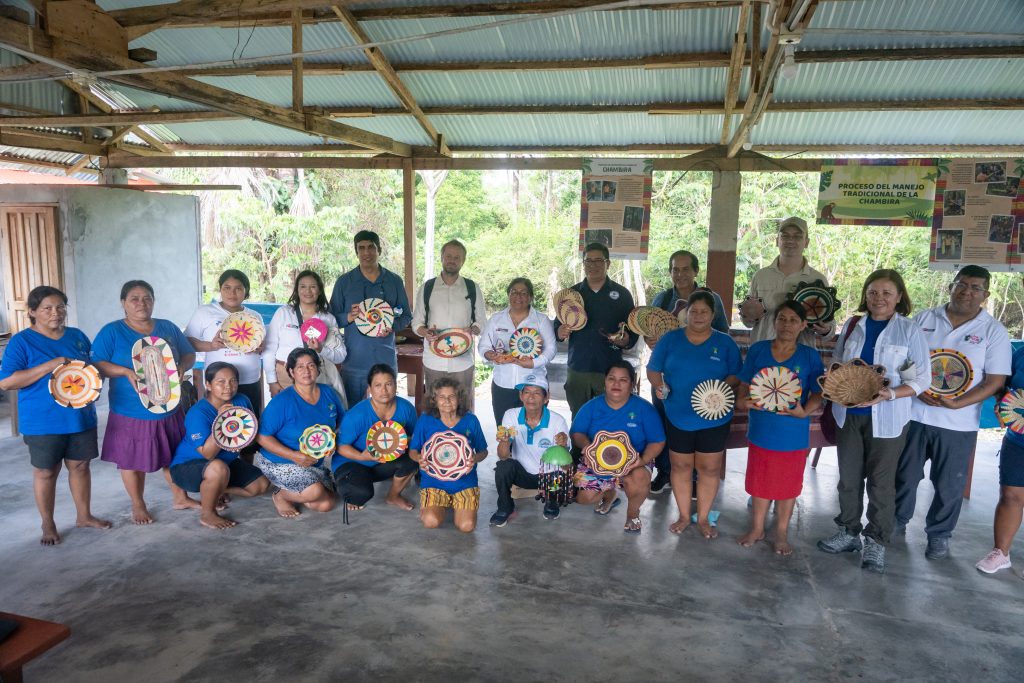
As part of the day's activities, visits were made to the rural communities of El Chino and Esperanza. There, the Local Vigilance Organizations (OLV) shared their experience in community patrols, which include the use of chalupas, smart phones and the Smart application, tools provided by the DCI project to improve monitoring and the quality of reports. They also learned about the work of productive associations such as the Puma Garza Artisanal Fishermen's Association, and the handicraft associations Manos Amazónicas and Cooperativa Esperanza del Bosque.
Advances in conservation
In Loreto, the DCI project intervenes in four Regional Conservation Areas, with a total goal to conserve standing forest of more than 2.2 million hectares in 2024 and the same value in 2025. In the Tamshiyacu Tahuayo Communal RCA, thanks to the articulated work of the headquarters and the nine VLOs, more than 54% of the annual goal has been patrolled by June 2025, making this area the second most advanced in Loreto. These actions are complemented by governance assemblies and the development of business plans that strengthen the capacities and economic opportunities of the local population.
The investment earmarked for strengthening RCAs through the ICD project in Loreto exceeds US$1.4 million between 2024 and 2025. This investment supports not only the protection of the forest, but also the active participation of communities in its management, aligning conservation with Peru's climate goals and the REDD+ approach.
In this regard, Torstein Skjeseth, Climate Change and Forestry Counselor of the Royal Norwegian Embassy, highlighted the importance of the RCA's sustainable management model. “I am here representing Norway because we are proud partners of the Peruvian government and the beneficiary communities in the conservation work in the Amazon. Knowing the RCA management model is key to ensure its management and sustainable development,” he said.
With these advances, the Tamshiyacu Tahuayo RCA is consolidated as an example of how the articulation between the State, communities and international cooperation can translate into concrete results for the climate, biodiversity and local wellbeing.
Regarding the Joint Declaration of Intent (JDI) – Phase 2
The Joint Declaration of Intent is a voluntary cooperation agreement signed by the governments of Peru, Norway, and Germany in 2014 to reduce greenhouse gas emissions from deforestation and forest degradation. The United Kingdom joined in the addendum signed for the period 2021–2025.
The DCI is led by the Ministry of the Environment and implemented by Profonanpe as the financial mechanism, with the participation of the Ministry of Agrarian Development and Irrigation, through SERFOR; the Ministry of Culture; the regional governments of San Martín, Huánuco, Ucayali, Loreto, Amazonas, and Madre de Dios; and the indigenous organizations AIDESEP, CONAP, and ANECAP. It also receives funding from the Norwegian Agency for Development Cooperation (NORAD). Learn more here.