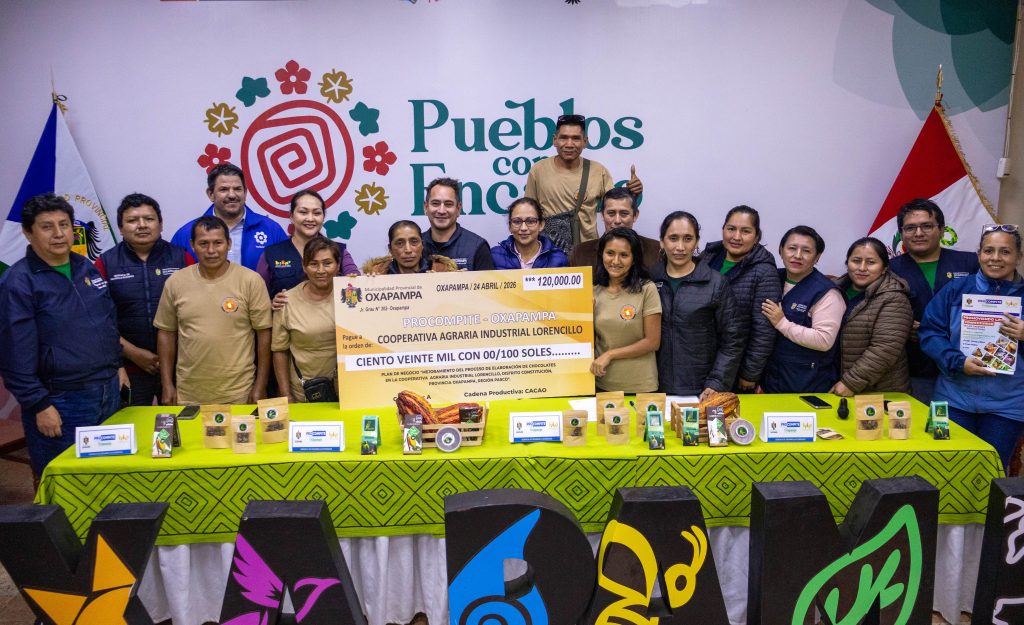
In a milestone for the management of local economic development in the Oxapampa-Asháninka-Yánesha Biosphere Reserve (BIOAY), the Provincial Municipality of Oxapampa (MPO), Devida and the Poli-LAC project celebrated the signing of the co-financing agreement with the Lorencillo Industrial Agricultural Cooperative, marking the beginning of a new era of a sustainable Procompite program.
Procompite Provincial has established itself as one of the main public financial instruments for boosting local enterprises. In this edition, however, the focus goes beyond economic profitability, incorporating environmental sustainability criteria thanks to the technical assistance of the Poli-LAC project, which has promoted the inclusion of biodiversity criteria in the competition rules and in the prioritization of production chains.
This strategic intervention ensures that the business plans financed are not only competitive, but also that they adopt pollinator-friendly practices. Among the main criteria incorporated are a commitment to zero deforestation, a reduction in the use of agrochemicals that affect pollinators, and recognition of ecosystem services, such as pollination, which is essential for local crops such as coffee, passion fruit and cocoa.
During the ceremony, Ignacio Piqueras, coordinator of the Poli-LAC project at BIOAY, highlighted the leadership of the Lorencillo Industrial Agricultural Cooperative for its entrepreneurial vision and for being a reference for this paradigm shift.
“This is the result of a clear political will. We congratulate the Provincial Municipality of Oxapampa and, in a very special way, the Management of Economic Development, for its openness to transform Procompite into a vehicle for sustainability.”, affirmed.
In the same vein, he stressed that “The commitment to BIOAY-friendly production chains is to ensure the future of our food security and our territorial identity”.
Cooperativa Agraria Industrial Lorencillo winner in the cocoa production chain
Photo: Provincial Municipality of Oxapampa
With the signing of this agreement, Oxapampa has positioned itself as a national benchmark, demonstrating that state competitive funds can become effective tools for active conservation. Poli-LAC's technical support will continue to strengthen this model, promoting development that articulates economic growth with the protection of pollinators and biodiversity.
About Poli-LAC
In Peru, the regional project “Protection of pollinating insects in Latin America and the Caribbean (Poli-LAC)” is led by the Ministry of the Environment, in partnership with the Pollinator Technical Group, the Ministry of Agrarian Development and Irrigation and Profonanpe, with the support of German development cooperation, implemented by GIZ, on behalf of the International Climate Initiative (IKI) of the Federal Government of Germany.