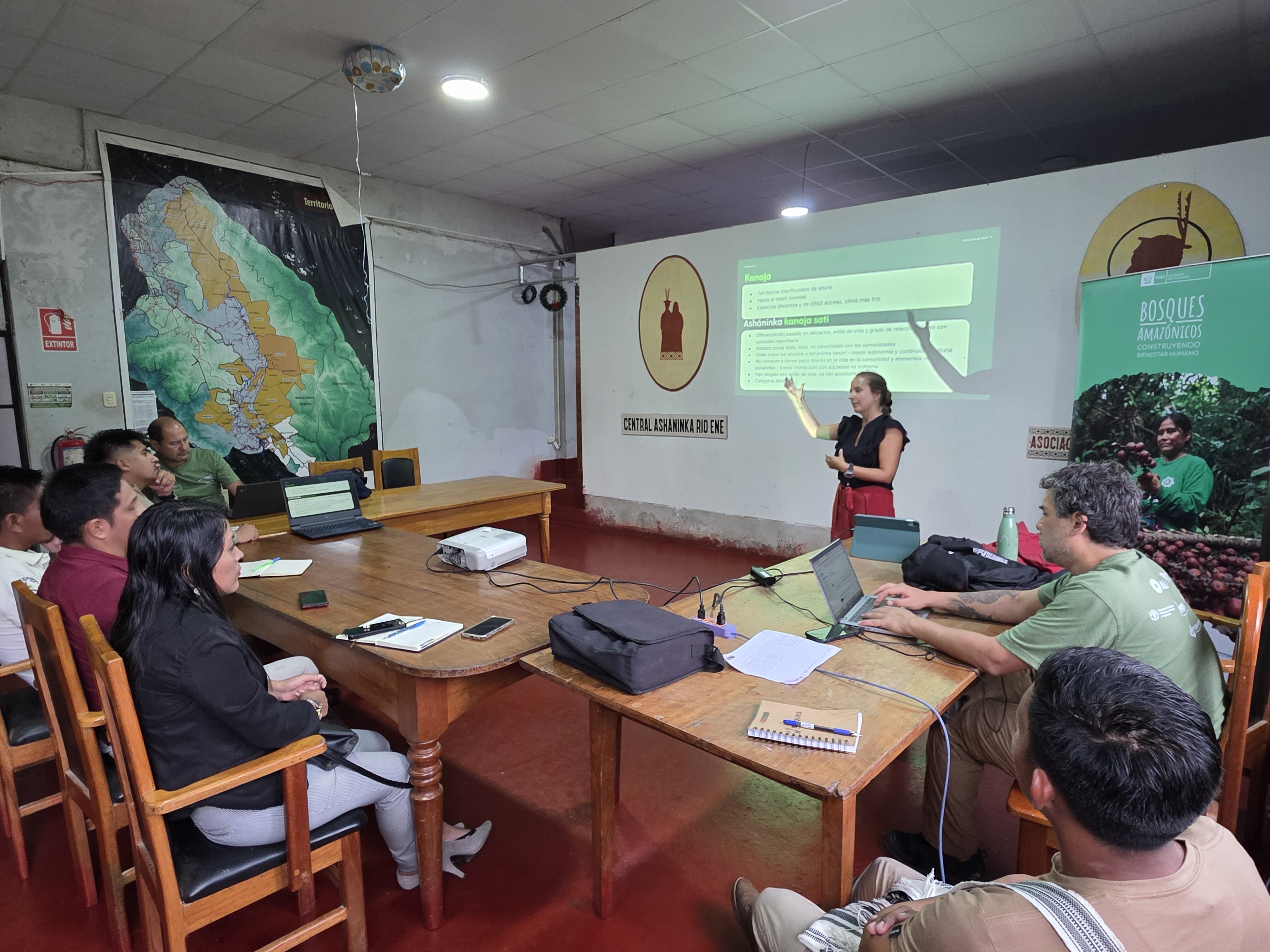
With the aim of boosting the competitiveness of Amazonian handicrafts and promoting their sustainable development, the project Amazonian Forests ASL2, led by the Ministry of the Environment (Minam), presented the diagnoses of the forest handicrafts value chain in the provinces of Atalaya (Ucayali) and Satipo (Junín). These meetings were held together with the project's strategic allies in the intervention territories, generating a space for dialogue to share findings, validate results and gather input from local stakeholders.
The appraisals show that handicrafts are an activity led mainly by women, who find in them a key source of income and economic empowerment. The craftswomen combine this work with domestic and agricultural responsibilities, and transmit their knowledge intergenerationally, preserving traditional designs, techniques and knowledge.
Among the main findings, challenges were identified such as the high level of informality in commercial relations, the limited traceability of products, and the high logistical costs that affect competitiveness, especially in territories with difficult access. Also highlighted was the existence of artisan associations, many of which are still in the process of formalization, which restricts their access to fairs, financing and support programs.
However, important opportunities were also highlighted: the growing demand in fair trade markets, the possibility of articulation with digital platforms for sustainable design, and the valorization of differentiating attributes of Amazonian handicrafts, such as their indigenous cultural identity, the use of natural inputs and sustainable practices with low environmental impact.
The workshops were attended by native communities, representatives of local and regional governments, partner institutions and artisan organizations, who agreed on the need to strengthen technical capacities, improve commercial coordination and position products in specialized markets.
As next steps, the project will promote actions to strengthen the handicraft value chain, including the implementation of training programs and investment plans in alliance with CITE Artesanía Ucayali, the validation of a traceability system, informative and capacity-building workshops, and coordination with strategic allies to facilitate better marketing and empowerment of participants. In addition, work will be carried out with public and private institutions linked to this chain to consolidate a support network that will enhance the sustainability and identity of Amazonian handicrafts.
About the “Amazonian Forests ASL2” project”
The project seeks to promote the conservation of healthy, functional and climate-resilient forests and wetlands; maintaining important carbon reserves, avoiding Greenhouse Gas (GHG) emissions and generating sustainable and resilient local livelihoods.
This initiative is being implemented by the Ministry of the Environment (MINAM), with funding from the Global Environment Facility (GEF); and has the support of the Food and Agriculture Organization of the United Nations (FAO), the International Fund for Agricultural Development (IFAD), the United Nations Industrial Development Organization (UNIDO) and Profonanpe.