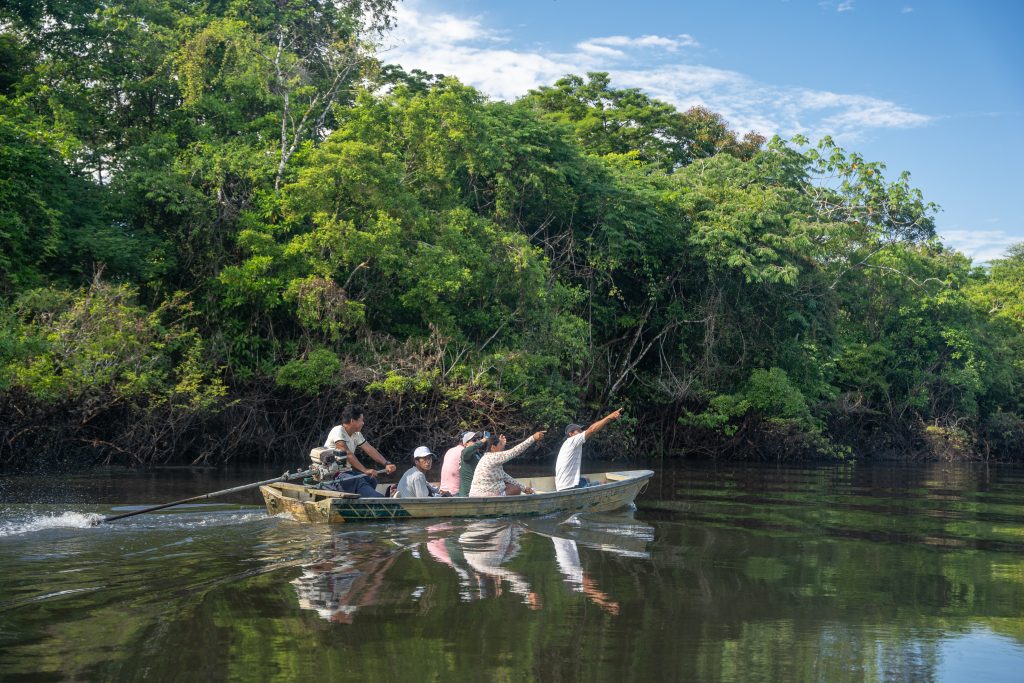
In the heart of Loreto, four Regional Conservation Areas (RCAs) are jointly managed by the Regional Government and native communities. With the support of the Joint Declaration of Intent (JIU) Financial Mechanism, they conserve the forest through surveillance patrols and strengthen their productive activities.
Community surveillance: technology and commitment in defense of the forest
Forest protection in Loreto is built every day on the ground, with the commitment of the communities through their local vigilance organizations. In the Tamshiyacu Tahuayo Communal RCA, organization has been key to protecting the territory. Gilberto Flores, community watchman, explains: “We as community members are committed. Every time there is a patrol, we unite to take care of what we have.
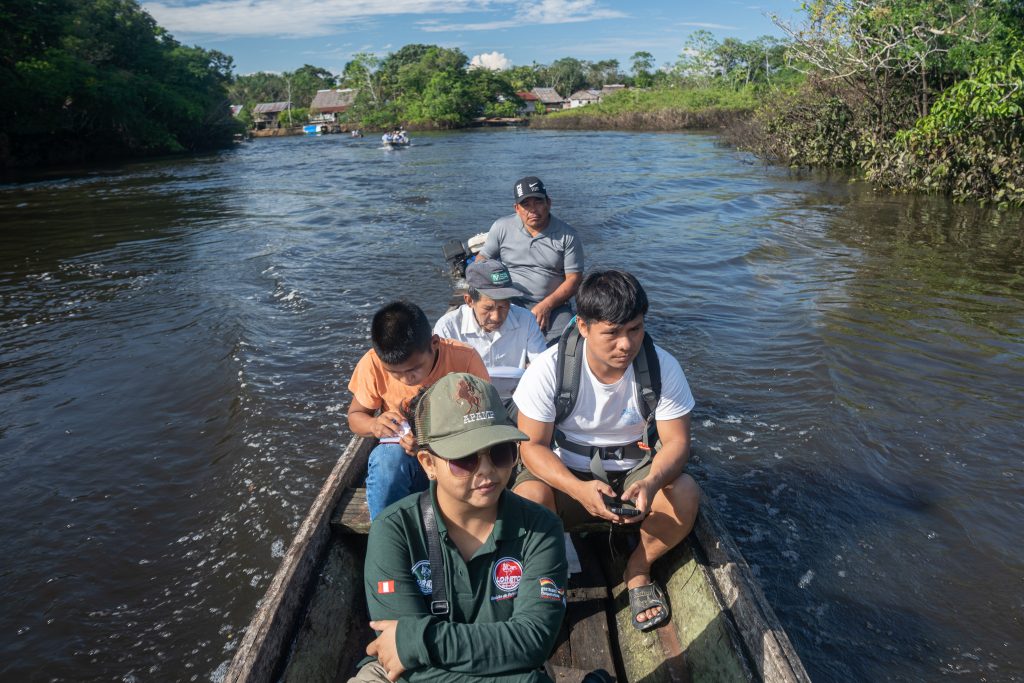
Gilberto Flores conducting community patrols in the area of influence of the ACR Comunal Tamshiyacu Tahuayo, Loreto region (Photo: Profonanpe).
This commitment has been strengthened with the support of the DCI's Financial Mechanism, strengthening community patrols with equipment, tools and logistics. “The support we receive in equipment and logistics with food and fuel is important to be able to go out on patrol. This facilitates our work, to do it in a more orderly manner,” says Rubiel Alvarado, community watchman of the Maijuna Kichwa RCA.
In addition, technology is a key element. Today, instead of recording observations on paper as they used to do before, the guards use the SMART application, installed on smartphones provided by the project. “There you fill in your start of patrol, your destination, where you are going, you mark your route, what you observe, and you can take photos,” explains Rubiel.
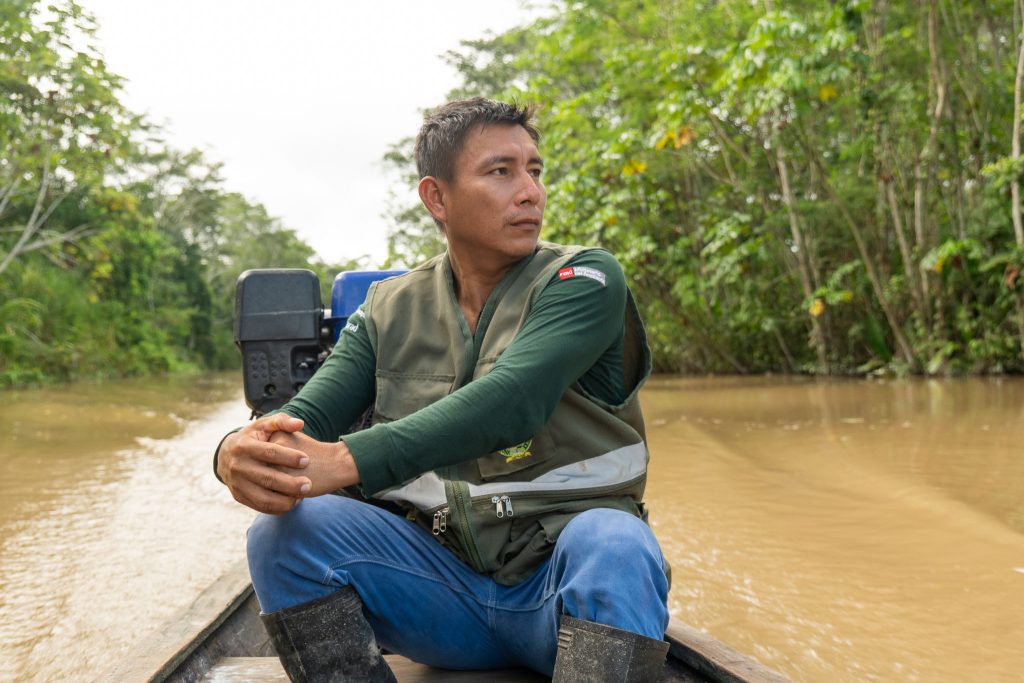
Rubiel Alvarado patrolling in the area of influence of the ACR Maijuna Kichwa, Loreto region (Photo: Profonanpe).
Isabel Ayala, head of the Tamshiyacu Tahuayo RCA, highlights the impact of this tool on community empowerment “The SMART strengthens the communities, it empowers them so that they can go out on patrols, leaving aside the patrolling format with a sheet of paper”.”
The community monitoring model, now more equipped, agile and accurate with the use of the SMART application, is an example of how joint management between the State, communities and international cooperation projects can translate into concrete results for conservation. In total, 16 smartphones have been delivered to the four Regional Conservation Areas in Loreto to strengthen this work in the field”.
Sustainable ventures: generating income while preserving
In the community of Porvenir de Inayuga, located in the area of influence of the Maijuna Kichwa RCA, a group of artisans has been transforming fallen wood from the forest into utilitarian pieces such as bowls, cake holders and mallets. This effort will be strengthened by the business plan being promoted for the association, which seeks to improve production conditions, expand the workshop and access new markets.
“We want to produce more crafts, more models, but we need tools and training. Right now we only have a small lathe and little space,” says Celso Dahua, a hardwood artisan. He and his colleagues make the most of the fallen trees, respecting the surrounding forest.
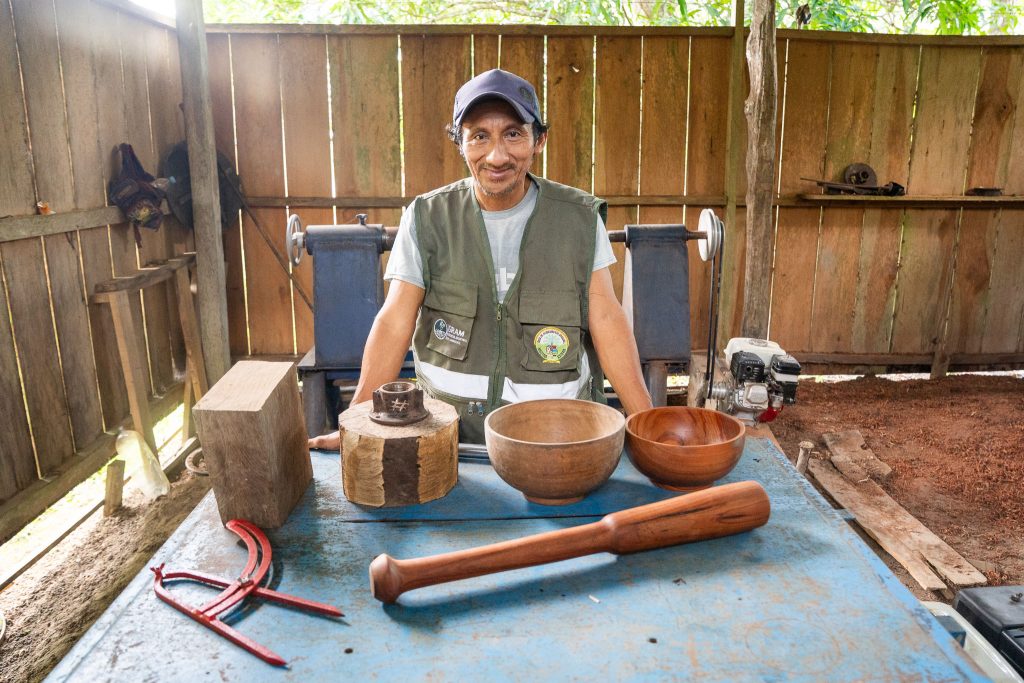
Celso Dahua at the hardwood handicraft production workshop of the Porvenir de Inayuga Artisans Association, Loreto region (Photo: Profonanpe).
Gledesi Rubio, also an artisan, shares the same expectation: “With the business plan we hope to have more profit for our family. We want more sales, and for that we need to improve our products, learn more with training, and have more lathes to work with.
This work is part of a broader approach to sustainable development. Enrique López, head of the Maijuna Kichwa RCA, explains: “The development of business plans will allow them to close gaps, obtain better economic income and make their activities sustainable. The expectation is that the communities will become empowered and generate their own resources, both for their families and also to support forest monitoring”.”
Homero Rivas, the consultant in charge of the business plan, emphasizes the potential of the association: “They were already working with hardwoods such as granadilla or palisangre, but now they are going to improve their workshops, their finishes, and standardize their production to reach larger markets. It has been demonstrated that this model is economically profitable and environmentally sustainable”.”.

Tools and supplies in the hardwood handicrafts workshop of the Association of Artisans of Porvenir de Inayuga, Loreto region (Photo: Profonanpe).)
The business plans thus allow conservation to be not only protection, but also a concrete opportunity for economic development for the communities, based on the responsible use of their resources and their knowledge of the territory.
Conserve with the communities or
The results in Loreto show that conservation is more effective when it is done from the territory and with those who inhabit it. With the support of the JIU's Financial Mechanism, integrated management based on monitoring, sustainable production and the active participation of native communities has been strengthened..
At the national level, the DCI has been supporting the management of nearly 2.5 million hectares in eight Regional Conservation Areas. Around 300 communities have benefited from surveillance patrols, strengthening their role in forest protection and contributing to the construction of a sustainable Amazon..
Regarding the Joint Declaration of Intent (JDI) – Phase 2
The Joint Declaration of Intent is a voluntary cooperation agreement signed by the governments of Peru, Norway, and Germany in 2014 to reduce greenhouse gas emissions from deforestation and forest degradation. The United Kingdom joined in the addendum signed for the period 2021–2025.
The DCI is led by the Ministry of the Environment and implemented by Profonanpe as the financial mechanism, with the participation of the Ministry of Agrarian Development and Irrigation, through SERFOR; the Ministry of Culture; the regional governments of San Martín, Huánuco, Ucayali, Loreto, Amazonas, and Madre de Dios; and the indigenous organizations AIDESEP, CONAP, and ANECAP. It also receives funding from the Norwegian Agency for Development Cooperation (NORAD). Learn more here.