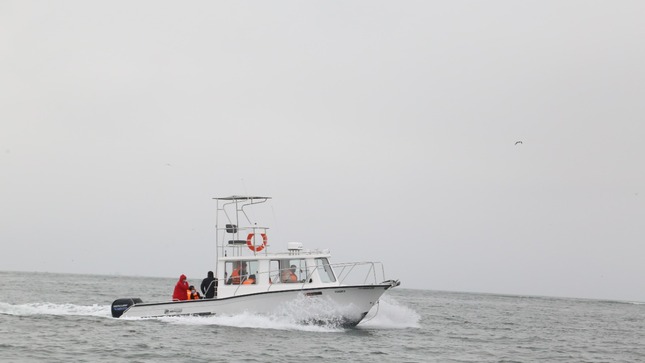
October 2021. With the aim of strengthening conservation and sustainable management actions for natural resources within the country's marine protected areas, the Ministry of the Environment, through the National Service of Natural Areas Protected by the State (Sernanp), implemented a new fleet of patrol boats that will be destined for the San Fernando National Reserve (Ica) and the National Reserve System of Islands, Islets and Guano Points.
The presentation and launch ceremony for these new vessels was led by the Minister of the Environment, Rubén Ramírez, who emphasized the vital role marine areas play in human development and the care of the planet. He stressed that this is why it is necessary to strengthen their conservation, and to that end, these vessels, equipped with the latest technology, are being deployed. They contribute to surveillance efforts, as well as to scientific research through the collection of marine evidence and the study of the seabed—information that contributes to conservation and the promotion of sustainable activities.
In this regard, the head of Sernanp, Pedro Gamboa, expressed his gratitude for the more than 50 years of support from the German Government, through international cooperation, in the conservation of protected natural areas and the generation of benefits for the population.

For his part, the German Ambassador to Peru, Stefan Andreas Herzberg, highlighted the strong alliance between German cooperation with the Ministry of the Environment and SERNANP (National Service of Natural Protected Areas) in improving the management and conservation of protected natural areas, as well as in the sustainable use of natural resources. "The PAN III project seeks to support Peru in the new challenge of managing marine areas with a focus on interventions that guarantee their sustainability and the protection of their biodiversity," he added.
Also participating in the ceremony were the general director of DICAPI, Cesar Ernesto Colunge; and the regional governor of Callao, Dante José Mandriotti.
Strengthening control and surveillance
The new vessels, with their equipment, speed, and capacity, will allow for joint operations and immediate response aimed at reducing the indiscriminate fishing of fish and mollusks, especially mackerel, octopus, and black snail, as well as ensuring the safety of visitors to both protected natural areas. Each vessel is equipped with radio, GPS, and radar, navigation lights and a searchlight, as well as safety equipment such as lifebuoys and life jackets, a fire extinguisher, a distress signal kit, and a survival kit.
Valued at $377,000, the acquisition of these patrol boats was made possible through contributions from KfW State Development Bank of the Federal Republic of Germany and channeled through the PAN III Project, and with the support of Profonanpe, Peru's environmental fund, demonstrating the importance of inter-institutional collaboration for strengthening the effective management of protected natural areas.
The boats have been manufactured with the technical specifications of the San Fernando National Reserve park ranger staff based on their field experience and the needs identified for the effective management of this marine protected natural area.
Resource management plan in San Fernando
Furthermore, with the aim of strengthening the sustainable management of natural resources and showcasing the great potential of protected natural areas as development hubs in the country, the development of the first plan for the extraction of hydrobiological resources in the San Fernando National Reserve was announced.
This plan will mark a milestone in Peru, by bringing together different sectors of the Government and will benefit 700 artisanal fishermen from the community of Marcona, with the opportunity to increase the value of resources by coming from a protected natural area with effective management, thus contributing to local economic development.
This initiative will be developed by SERNANP in conjunction with the PAN III Project and the Ministry of Production, within the framework of the Fisheries Management Regulations for Benthic Resources. Furthermore, it will involve close collaboration with the Marcona fishing community, which comprises 17 artisanal fishing organizations, incorporating their experience as key stakeholders in the management of marine invertebrate resources such as sea urchins and macroalgae.
Source: Sernanp