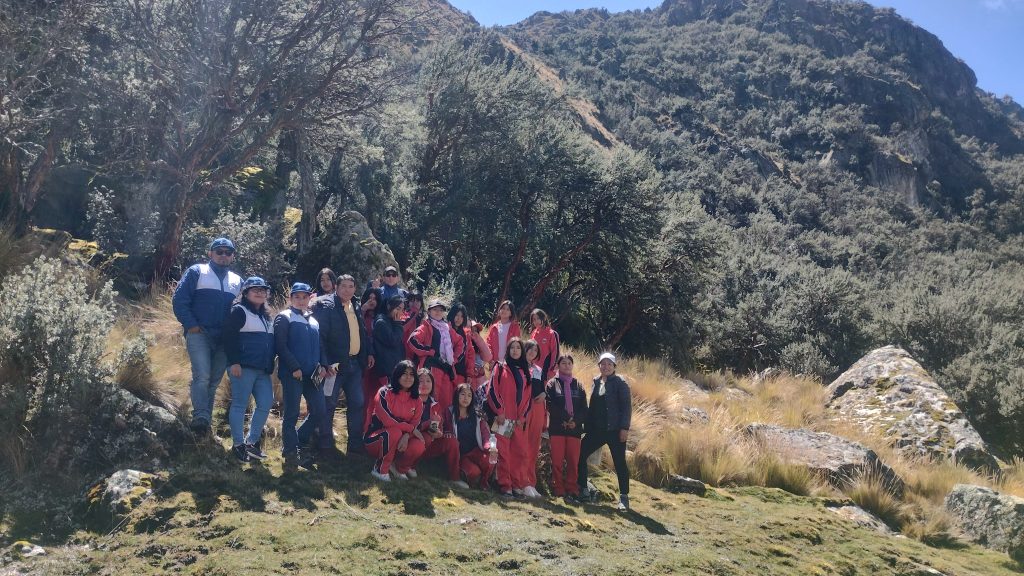
Students from IE Micaela Bastidas de Tamburco present in the relict forests of queuña - © IDMA
Last April 16, more than 20 students and teachers from the I.E. Micaela Bastidas de Tamburco participated in an educational day in the Mariño watershed, ecosystem representative of the proposed creation of the Rontoccocha Regional Conservation Area (RCA). The activity, organized by the Institute of Development and Environment (IDMA) in coordination with EMUSAP Abancay, The purpose of the project was to bring young people closer to the ecological knowledge of the territory, strengthen their bond with the natural environment and reflect on their role in environmental conservation.
Route planning
The day was coordinated with the school's management and teachers, who actively accompanied the tour. IDMA's technical team, together with EMUSAP staff, designed an educational route based on key points of the high Andean landscape, integrating environmental content, monitoring tools and participatory activities.
Along the route active participation of students was encouraged. through questions, observation exercises and spaces for dialogue. The approach was experiential, adapted to the school level, and emphasized the link between high altitude ecosystems and the provision of water for the city of Abancay.

Visit to the relict forest of queuña, grasslands and wetlands. - © IDMA
During the morning, the students visited the altitude camp, where they learned about the ‘Water Route’.’ where they were told about Ecosystem Service Compensation Mechanisms (MERESE) and the proposed Rontoccocha Regional Conservation Area (ACR), executed by IDMA. Later, they went to the relict queuña forests, where they understood their ecological importance and their role in local biodiversity. In the Rontoccocha ecosystem, they explored the restoration processes and the hydrological monitoring system implemented in the area.
The visit continued with an active break and a trip to the Mariño viewpoint, where the problems of urban sprawl, the challenges for territorial planning and the need for responsible management of water resources were discussed. The day ended with a final reflection before returning to the city.
What did the visit achieve?
The experience allowed participants to better understand the ecological value of the bofedales, lagoons and queuñales, and to generate significant awareness of the importance of the Rontoccocha RCA, especially in relation to the conservation of endangered birds and regional water security.

Visit to the hydrobiological monitoring station and socialization of the work carried out by the MERESE program. - © IDMA
In addition, the links between formal education and territorial conservation were strengthened, highlighting the value of the MERESE program as a water management mechanism. It was noted that this type of integrative initiative allows students to internalize ecological and territorial concepts more clearly.
The use of accessible language, The teacher accompaniment and the use of visual resources favored significant learning, strengthening the environmental commitment of young people.
A future for ACR Rontoccocha
The Rontoccocha RCA proposal is currently in its third stage, focused on socialization with the sectors that have real rights within the proposed area. This phase seeks to promote spaces for dialogue and consultation, prior to prior consultation with the 11 rural communities recognized as indigenous peoples. This process will guarantee their informed participation and respect for their collective rights, in accordance with the current regulatory framework.
The Conserva Ave Initiativeis led by the American Bird Conservancy (ABC), National Audubon Society (Audubon), Bird Life International, Birds Canada and the Latin American and Caribbean Network of Environmental Funds (RedLAC). The national partners are Profonananpe and ECOAN, leaders of implementation in Peru, with funding from the Bezos Earth Fund.
Join us
Yerssey Caballero Palomino
IDMA Apurimac Program Director
directorabancay@idmaperu.org
Yasmine Rosas Damian
Project Coordinator
yasmine.rosas@idmaperu.org