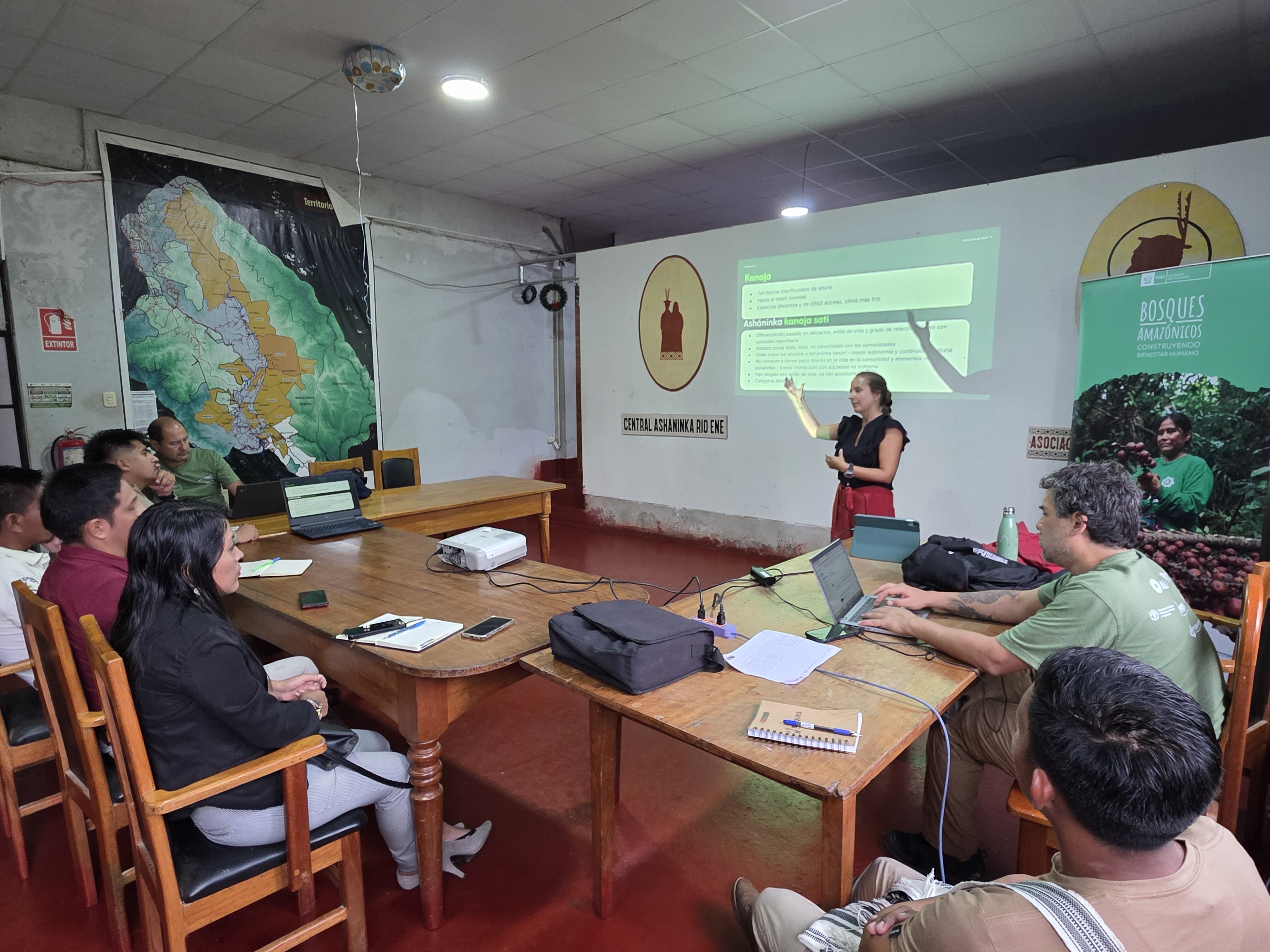
The training was developed within the framework of the Training Program for Managers of Regional Conservation Areas, promoted by the National Service of Natural Areas Protected by the State (SERNANP), in coordination with the Spanish organization EnElMedio and Profonanpe, through its ACR+ project.
Through a theoretical and practical course, participants were not only trained but also certified as instructors, which will enable them to replicate the contents in their territories and form community support brigades. In this way, it seeks to strengthen the articulation between public institutions and civil society linked to risk management and emergency response.

Photo: Profonanpe
In the towns of Pucallpa and Campoverde, the new instructors put into practice what they learned in two parallel courses for local brigadistas, with the direct accompaniment and technical advice in the field from the Spanish specialists who participated in their training. The methodology ensures that the knowledge is transferred with appropriate technical standards and is installed in the territories as a permanent capacity.
The urgency of this type of intervention is evident. According to the Peruvian Geophysical Institute, in the last two decades forest fires have severely impacted several regions of the country, affecting thousands of hectares of ecosystems. A report by the specialized portal Mongabay warns that in the last 12 years alone, forest fires in Peru have damaged 2.3 million hectares of natural and agricultural cover, an extension comparable to the area of Metropolitan Lima burned ten times over.
The Multisectoral Plan for Forest Fires 2025-2027 also warns about the magnitude of the risk: more than 511 thousand people, more than one million agricultural hectares and 1,395 archaeological monuments are located in areas classified as very high risk. Against this backdrop, strengthening prevention, monitoring and response preparedness -with a preventive, intercultural and gender focus- is essential.
 Photo: Profonanpe
In this context, initiatives such as this specialized training process not only seek to address emergencies, but also to build sustainable local capacities that allow timely, coordinated and effective action in the face of a threat that impacts both biodiversity and the safety and well-being of communities.
Present at the launching activity were Jeanette Noborikawa, coordinator of the ACR+ Project of Profonanpe, Jesús Blanquer Aznar, representative of the Spanish organization EnElMedio, Catalino Castilla, representative of SERNANP, along with representatives of ANP and ACR of the Regional Government of Amazonas - Gore Amazonas, he Regional Government of Ucayali - Gore Ucayali and the Regional Government of San Martin.