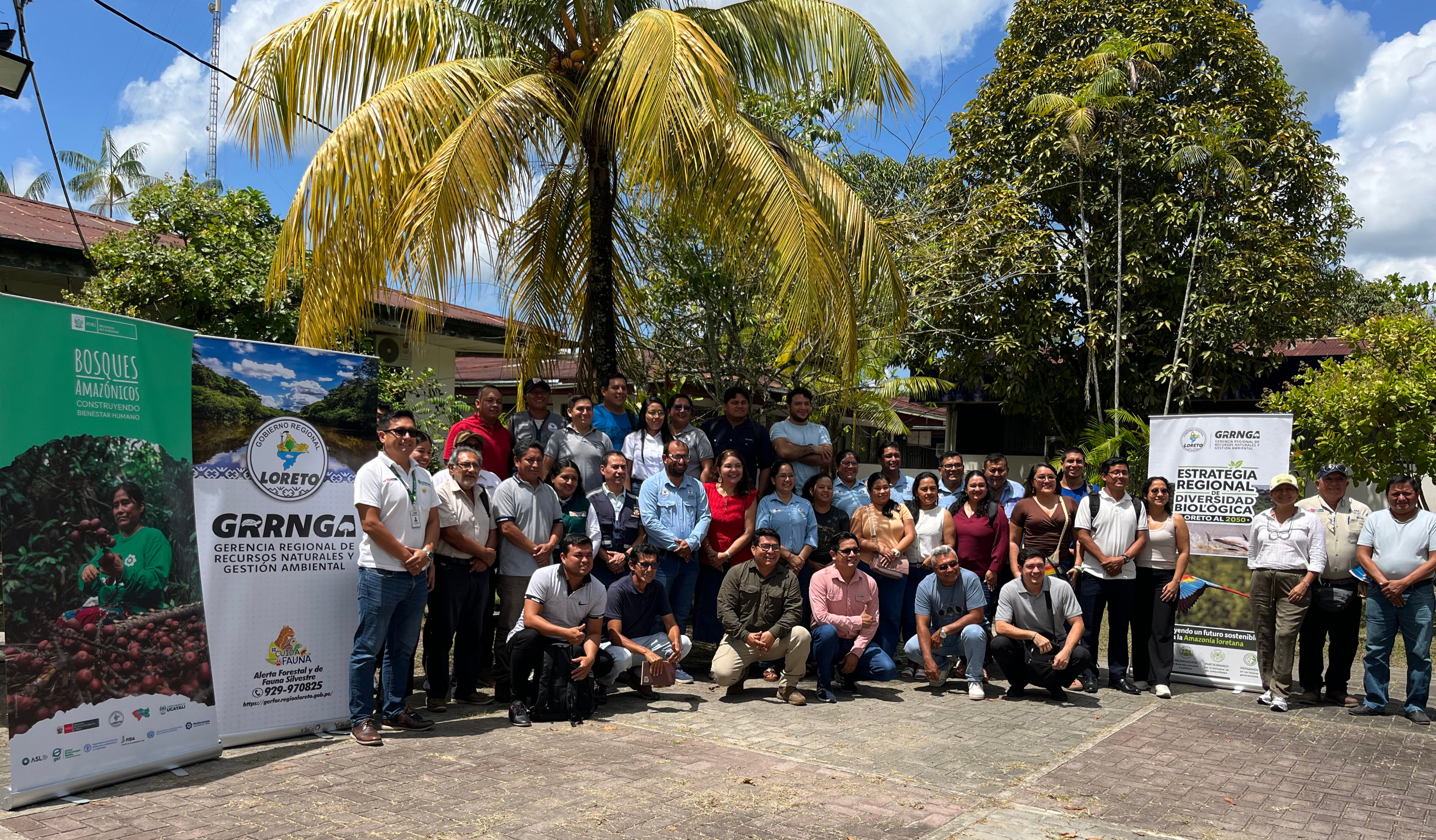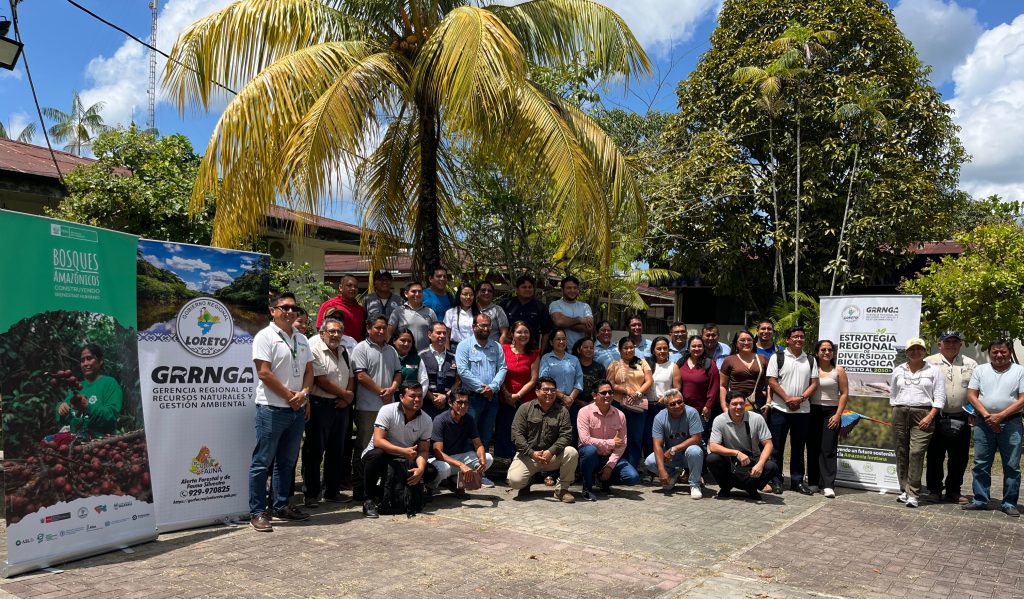
The Regional Government of Loreto, through the Regional Directorate of Natural Resources and Environmental Management (GRRNyGMA), presented an update to the Loreto Regional Biodiversity Strategy (ERDB Loreto 2030, with a strategic horizon extending to 2050). This initiative was supported by the Amazon Forests – ASL2 project as part of the priority actions in the Loreto region aimed at strengthening institutional frameworks and planning tools that enable sustainable land management.
The Loreto ERDB is a key tool that adapts national and regional policies to local realities; it strengthens governance and coordination among institutions; helps address challenges such as forest loss, deforestation, environmental liabilities, and threats to flora and fauna; and allows for the prioritization of measures needed to achieve the expected impacts related to food security, water security, sustaining the carbon reserve in the Amazon, and, above all, preserving communities’ livelihoods and improving local and regional economies.
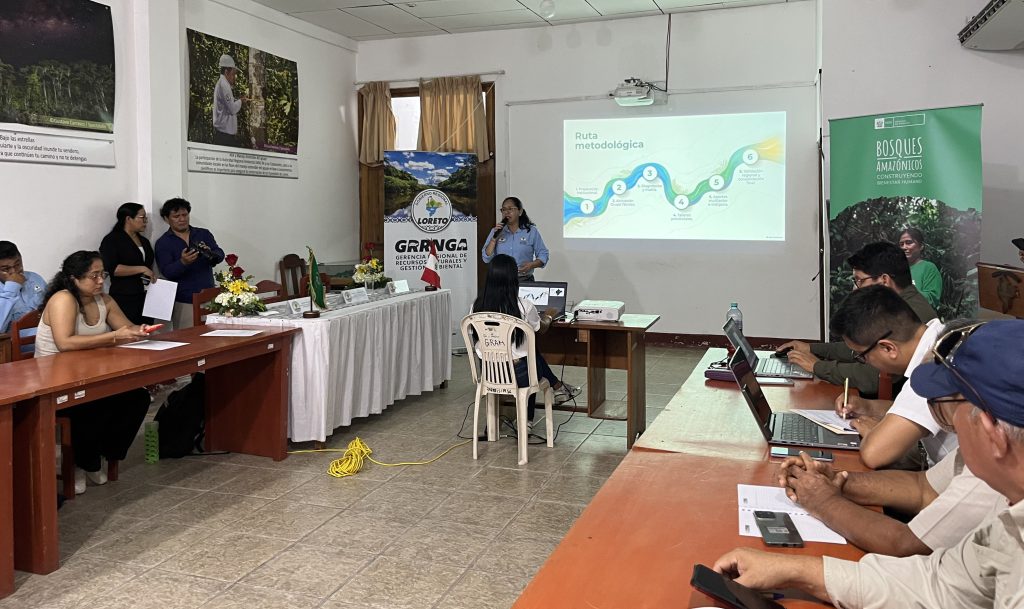
Milagros Gonzales, from the Loreto Regional Government (GORE), shares details about the participatory process of developing the strategy.
This instrument was developed through a participatory process involving indigenous and riverside communities, academia, civil society, the private sector, and public entities at various levels of government. The process included provincial workshops, bilateral meetings, and input from experts, and culminated in the regional workshop in Iquitos.
Loreto is Peru’s largest department, covering 368,851 km² (28.7 % of the country’s total land area) and comprising nearly half of the Peruvian Amazon. The assessment underpinning the strategy indicates that 83 % of the region’s territory is covered by forests and that 35.6 % of its land area (more than 13.3 million hectares) is under some form of conservation, including Protected Natural Areas, Regional Conservation Areas, Private Conservation Areas, and Fragile Ecosystems. The same assessment reports annual deforestation of 37,987 hectares recorded in 2024 and a cumulative loss of 581,095 hectares over the past two decades, figures that support the update of the strategy for the 2030–2050 timeframe.
On this basis, the Loreto Regional Development and Planning Board (ERDB) has set as its central objective the reduction of pollution and degradation of the department’s Amazonian water and forest ecosystems through strengthened institutional frameworks, the sustainable use of natural resources, and land-use planning, guided by a strategic vision of an Amazonian development model based on biodiversity, landscape connectivity, effective management of conservation areas, and respect for the rights of communities and the general population. The ERDB is broken down into 22 regional goals and 88 actions, each with defined indicators, baselines, and responsible institutions through 2030.
Ray Harris Del Águila Montero, an engineer and deputy regional manager for Conservation and Biodiversity at the Regional Environmental Office of the Loreto Regional Government, stated that: “Updating the Regional Biodiversity Strategy allows you to set the department's conservation priorities, strengthen our environmental institutions, and make evidence-based decisions in response to the pressures facing our forests and wetlands”.
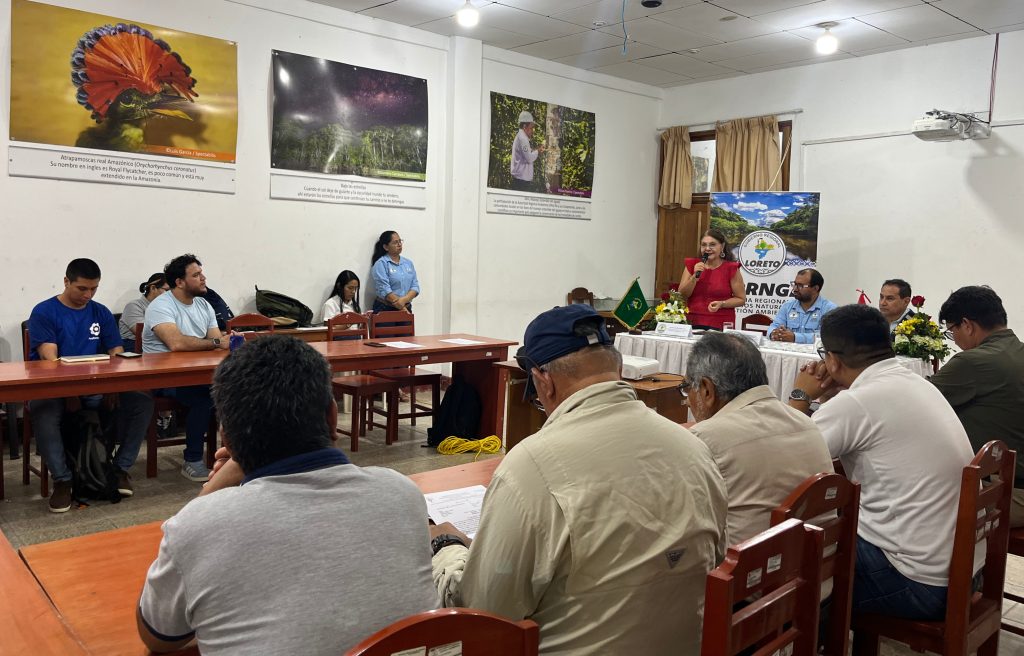
Cristina Portocarrero, Technical Coordinator of ASL2, during her presentation on technical support for the process.
For her part, Cristina Portocarrero, technical coordinator of the Amazon Forests – ASL2 project, stated that: “Through the ASL2 project, we provide technical support for this process because we believe that having an up-to-date, participatory regional biodiversity strategy with measurable goals is key to strengthening the conservation of Loreto’s forests and wetlands, and that it serves as a tool to foster the dynamics of a sustainable bioeconomy that translates into livelihoods for the local population.”.
The Amazon Rainforests – ASL2 project is led by the Ministry of the Environment, funded by the Global Environment Facility (GEF), through the Food and Agriculture Organization of the United Nations (FAO), he International Fund for Agricultural Development (IFAD) and the UNIDO, with Profonanpe serving as our operational partner in the region.