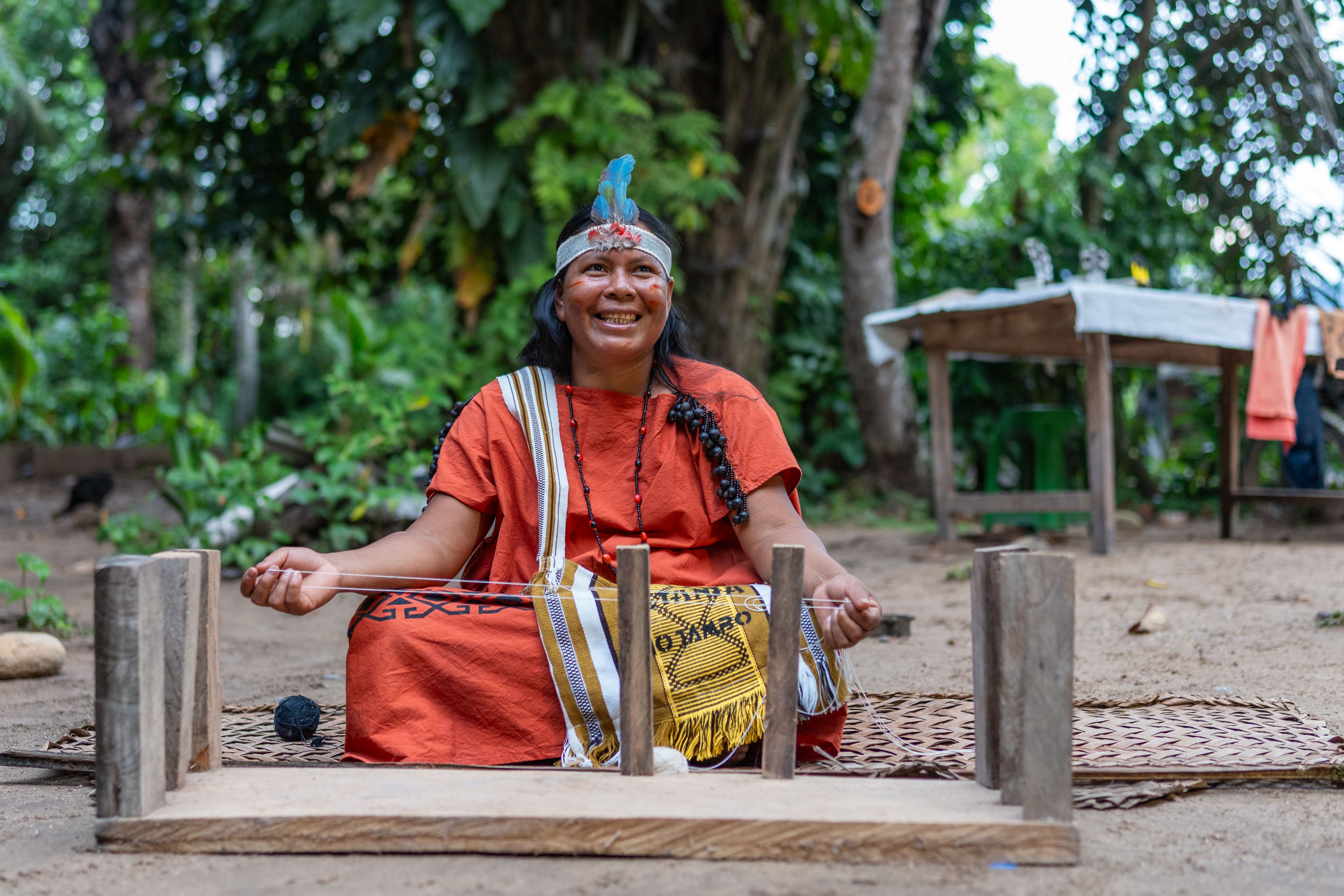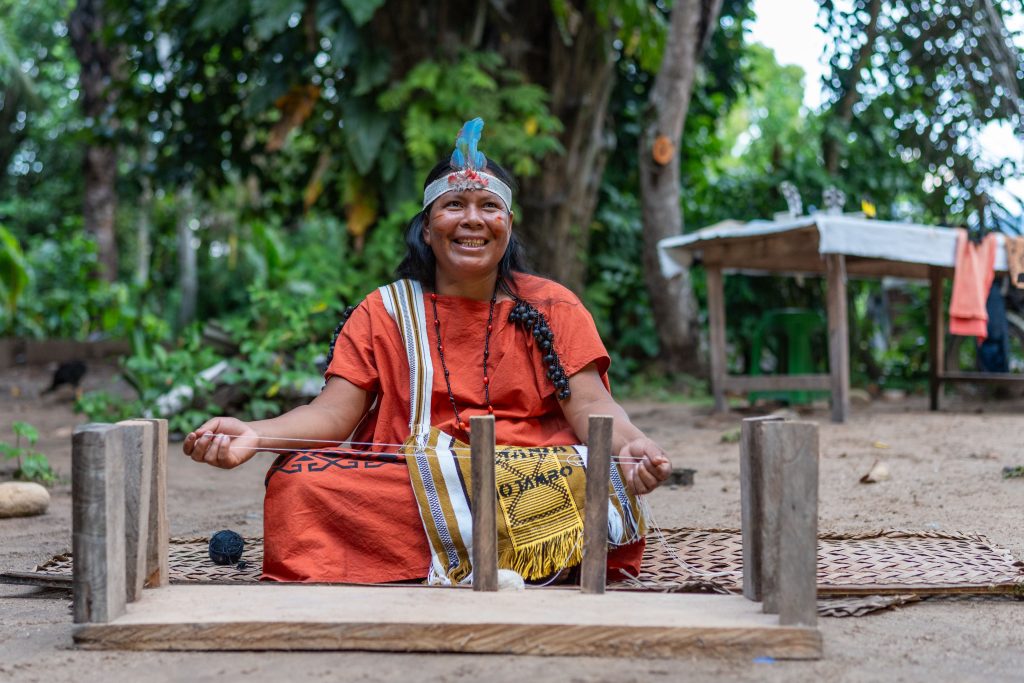
In the Betania Indigenous Community in Satipo, Mechi Tomás Maguiño (38) weaves, farms, and runs her own business. She earns her income from these three activities combined. In addition to running her business, “Manos Forjadoras a la Moda,” she chairs an association of 11 women artisans who seek to strengthen their production and gain access to better commercial opportunities.
Her journey, however, did not begin at the loom. A graduate of the Asháninka Institute in Puerto Ocopa with a degree in agricultural technology—just like her husband—she worked in a profession that required constant travel and long days in the field. She would spend several days away from home, and over time, her children began asking her to be there more often. She, too, was concerned that these absences would weaken her bond with them.
That is why she decided to look for an alternative that would allow her to stay in her community without giving up her financial independence. She began saving part of her salary to buy supplies and settle permanently in Betania. There, she opened a small store and, at the same time, found in textile crafts a way to generate income and strengthen her cultural identity.
The Memory of the Loom: Tradition and Innovation in Handicrafts
Her connection to textiles dates back to her childhood, when she watched her mother drive stakes into the ground to weave cotton threads. To make her first garment, she unraveled an old green-and-red wool sweater and reused the threads on a small loom. That piece was stolen from her before she could finish it, but the experience sparked an interest in craftsmanship that would stay with her for years to come.
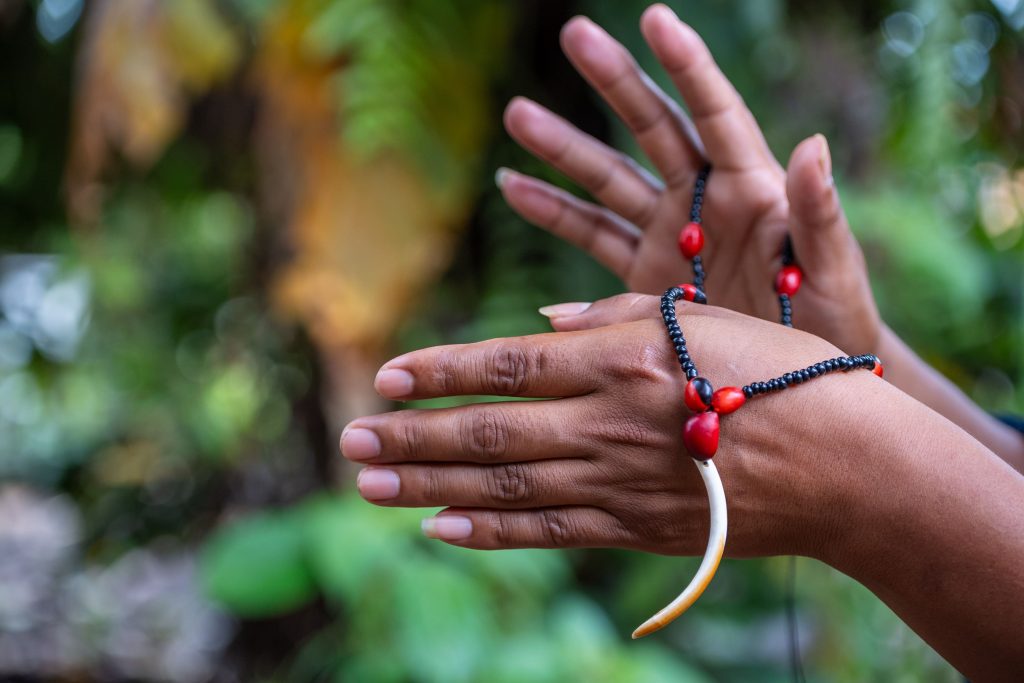
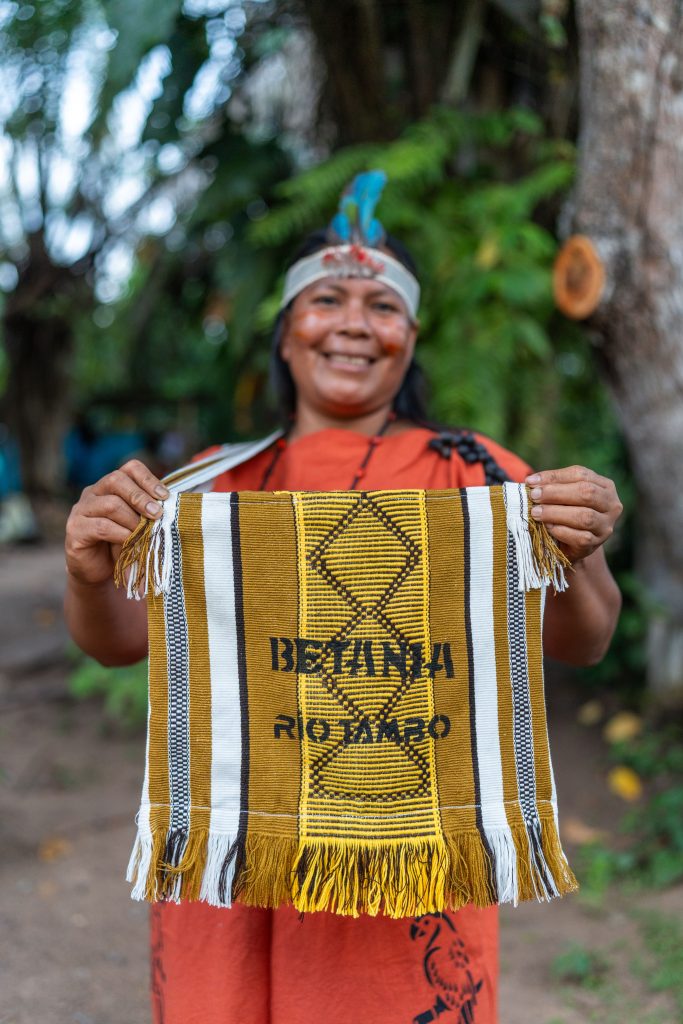
Today, it produces the kushma, traditional clothing for men and women, and the zaratos, bags typical of the region. She also creates jewelry using seeds from huayruro, majáz teeth, and feathers from native birds such as the paukil and the parrot.
In addition to these traditional techniques, there is also eco-friendly dyeing: it uses achiote to achieve warm tones and leaves of little guy combined with alum to produce other pigments. In this way, their traditional knowledge is combined with new design possibilities.
Community Leadership and the ‘Manos Forjadoras’ Brand’
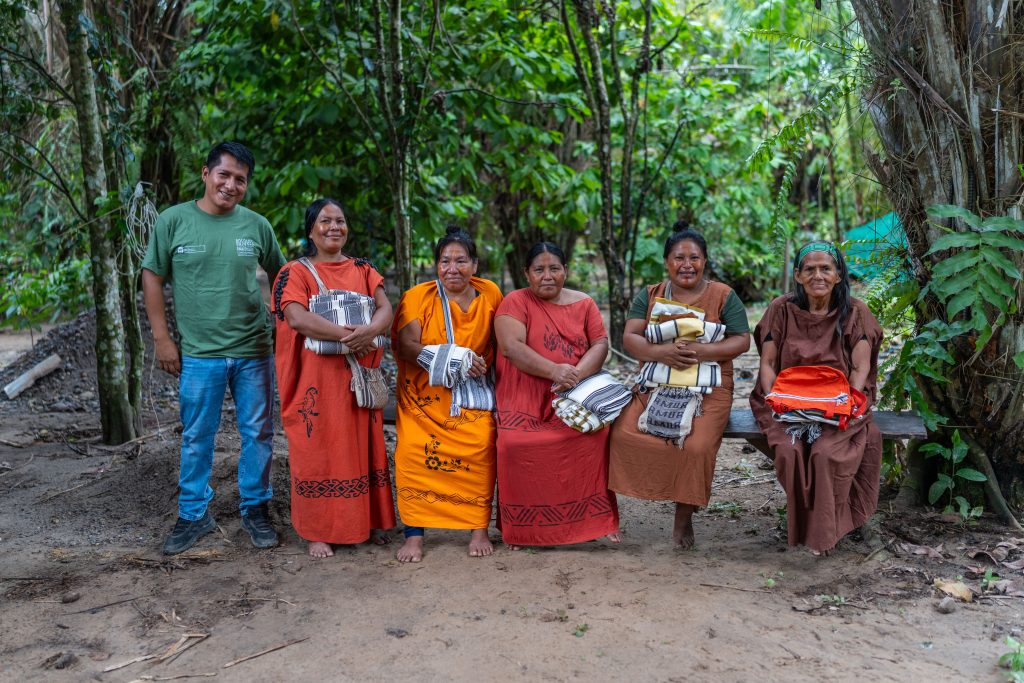
What began as a way to generate income also became an opportunity to support the work of other women. In 2024, she reached two milestones: she registered with the National Artisans Registry (RNA) and launched her personal brand, “Manos Forjadoras a la Moda.” That same year, she became president of the Betania Artisans Association, where she coordinates the work of its 11 members; her term runs through 2027.

As president, she promotes the collective purchase of industrial cotton thread, a measure that reduces production times and prevents material shortages in the community. She also seeks to strengthen her colleagues’ business skills and encourages them to negotiate prices that reflect the value of their work.
The latter is key in the face of “price haggling,” one of the sector’s main challenges: some middlemen try to drive down the price of garments—which artisans offer for 50 soles—to 35 or 40 soles. For this reason, Mechi believes it is essential for women artisans to have more tools to market their products directly and defend the economic value of their creations.
Her organizational skills are also evident in the orders she handles. On one occasion, she was tasked with preparing 30 zaratos for the Satipo market—a challenge she took on with the support of her aunt and other women in her community. To meet the one-month deadline, they coordinated the production process and even worked through the night to keep up with demand. When the community’s power went out, they continued working by the light of a solar panel.
Economic Diversification: Between Home, Farm, and Loom
Although textiles play an important role in her life, they are not her only source of income. Her day begins between five and six in the morning. After making breakfast for her children and taking care of household chores, she opens the store. While serving customers, she uses her free moments to work on her handmade garments and accessories.
On top of that, there’s farm work. Together with her husband, she grows cacao, plantains, and cassava on their farm. During the cacao harvest season, she also generates income for other women in her community: she hires her aunts, sisters, and neighbors who need work and pays them a daily wage to harvest the fruit, which she then sells at the Atalaya market.
This combination of activities has allowed her to diversify her sources of income and put her technical, agricultural, and artisanal skills into practice. At the same time, it has given her a work routine that keeps her close to her children—the reason she decided to start her business in Betania.
From Bethany to the World: A Vision for Asháninka Handicrafts
After establishing a foothold in the community, their next goals are focused on expanding the reach of their business. One of these is to strengthen the brand identity of their products. Following recent recommendations, they plan to use labels bearing their brand name instead of the stickers they currently use, so that each Kushma, Zarato or accessory can be identified by its origin and the craftsmanship it represents.
She also sees digital tools as an opportunity to reach new audiences. Her own son jokingly encourages her: “Mom, make your own TikTok”. She wants to learn about social media so she can showcase her botanical dyeing processes, promote her creations, and sell them directly.
She has already had some experiences that allow her to envision that growth. She recalls with satisfaction meeting visitors who were using her products and seeing a senator wearing one of her zaratos during events in the Peruvian highlands.
Her aspirations, however, extend beyond her own business. As a leader, she understands the challenges faced by the members of her association in sustaining and expanding their sales. Unlike cacao, which has an established marketing network in Atalaya, indigenous handicrafts lack permanent markets and commercial conditions that ensure the producers’ work is properly valued. Added to this are transportation costs, difficulties in accessing materials, and dependence on middlemen.
Despite these obstacles, his vision is ambitiousa: to establish direct export channels and position Ashaninka handicrafts in international design circles. She would like to see the garments from “Manos Forjadoras a la Moda” featured on an international runway someday and, above all, for the work of the women artisans in her community to receive the recognition it deserves for its cultural, creative, and economic value.
Strengthening Indigenous Crafts and Their Commercial Opportunities
The challenges she identifies as an entrepreneur and leader are not unique to Betania. Many women artisans in Satipo face high transportation costs, difficulties in accessing financing, and limitations in marketing their products on a sustained basis—factors that hinder the growth of their businesses.
To help bridge these gaps, the Amazon Forests ASL2 project promotes the strengthening of the indigenous handicrafts value chain through training, the provision of materials, and participation in fairs and commercial venues. These actions are aimed at improving production and management capabilities, strengthening small businesses, and facilitating access to new markets.
This initiative is part of a broader effort: to contribute to the conservation of the Amazonian forests and the well-being of communities through sustainable economic activities. Within the handicraft value chain, this involves creating conditions that allow Indigenous women to expand their income-generating opportunities while preserving and passing on knowledge related to the biodiversity and cultural identity of their peoples.
Mechi’s journey shows that economic independence can be built through various activities, decisions, and forms of organization. From Betania, she continues to work to strengthen her business and open up commercial opportunities that also benefit the other artisans in her community.
He Amazonian Forests Project ASL2 is led by the Ministry of the Environment, funded by the Global Environment Facility (GEF), implemented by the FAO, he International Fund for Agricultural Development (IFAD) and the UNIDO, and implemented by Profonanpe.