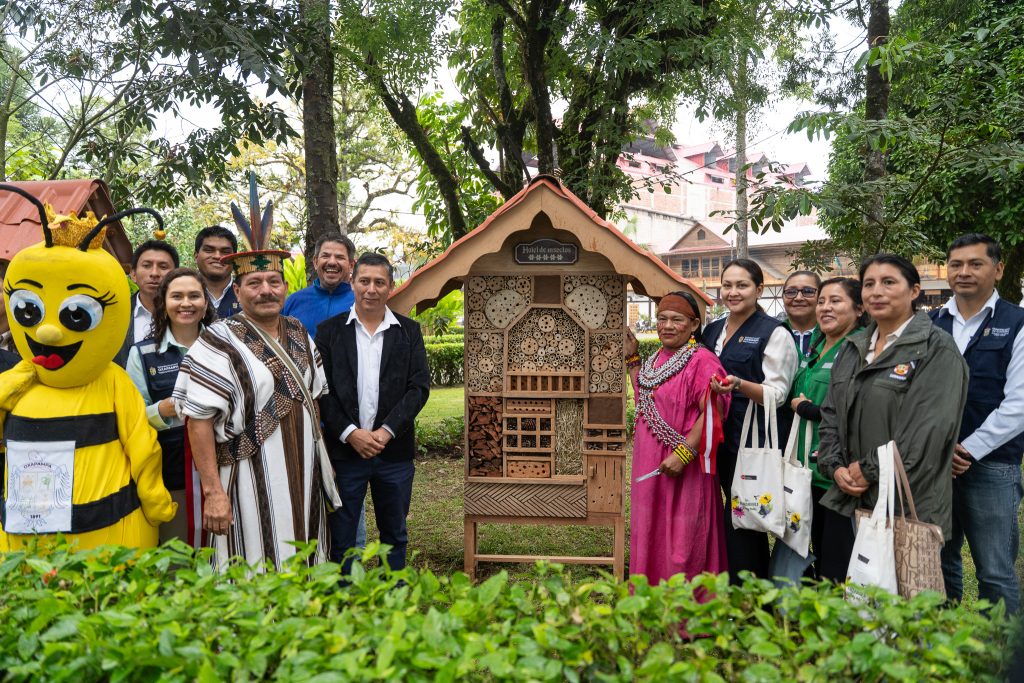
Presentation of the first insect hotel in Oxapampa's main square.
Photo: Profonanpe
More than 100 people, including school children, local authorities and representatives of the native peoples of Oxapampa, came together on May 20 to celebrate World Bee Day with the inauguration of their first insect hotel. The activity was part of an educational and community day organized by the Poli-LAC project, in coordination with the Provincial Municipality of Oxapampa, Sernanp and various local partners.
The day began with a colorful parade featuring school children, public entities and native communities, who paraded with educational messages in defense of pollinating insects. This activity sought to strengthen environmental awareness from an early age, highlighting the importance of joint work between the State, international cooperation, civil society and indigenous peoples.
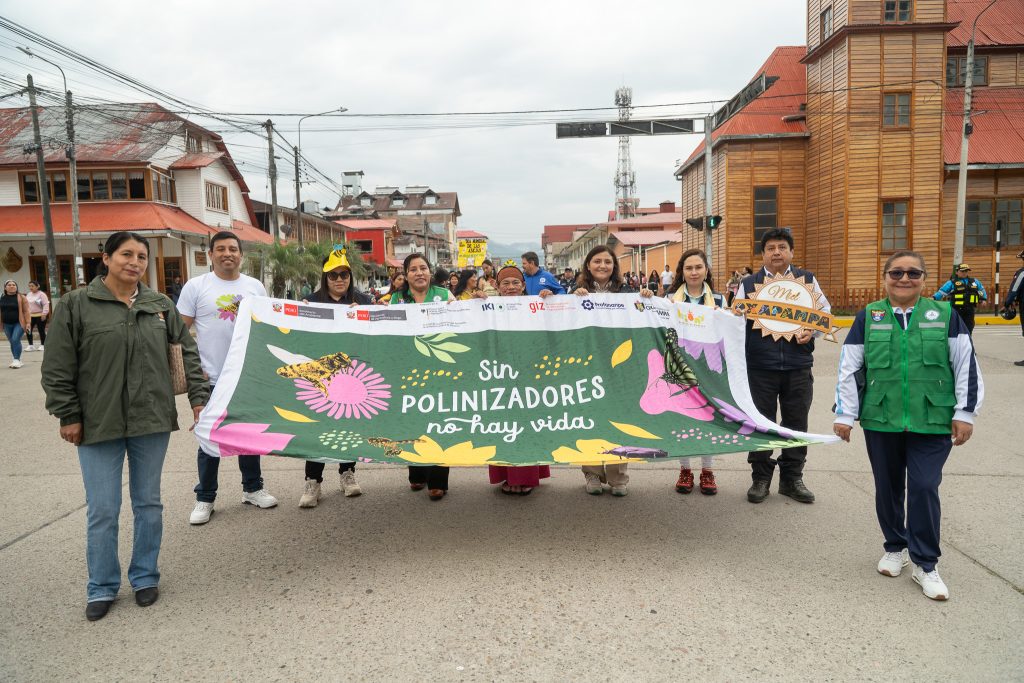
Educational parade under the slogan «Without Pollinators there is no life» in Plaza de Armas of Oxapampa
Photo: Profonanpe
“We are committed to integrating conservation with environmental education, involving children and young people in the care of these vital insects, through the strengthening of school brigades and the development of green spaces. But also, through the articulation between the institutions present, because that way we can accelerate changes.”, explained Ignacio Piqueras, coordinator of the Poli-LAC project.
The inauguration of the insect hotel, located in the Plaza de Armas of Oxapampa, was attended by representatives of the Provincial Municipality, the Association of Ashaninka Communities of the Pichis Valley (ANAP), the Federation of Native Yánesha Communities (Fenconaya) and representatives of Kowen Antami as well as the Yanachaga Chemillén National Park. The structure is designed to house various pollinating insects such as solitary bees, lacewings, earwigs and solitary wasps, offering them a safe haven where they can rest, reproduce and actively contribute to natural pollination in the area.
During the activity, the fundamental role of indigenous women in the conservation of the environment was also highlighted. “We continue to conserve our bees, because they give us health, knowledge and our medicinal plants. As a woman, I come to share and exchange knowledge. The bees give us strength, we will continue working and reforesting.”, said Marisol Shariva, vice president of ANAP, highlighting the connection between biodiversity and community action.
The cultural value of bees was also highlighted by Jaime Chihuanco, Feconaya's cornesha, who said: “The bee product is a healing thing. Our ancestors knew its importance; that's why we don't cut down trees, we preserve them for years and keep our forest green.”.
Both environmental and local authorities reaffirmed their commitment to the protection of pollinating insects. Salomé Antezano, head of Yanachaga Chemillén National Park, emphasized that one of the park's main objectives is to conserve this valuable ecosystem service. In turn, the provincial mayor of Oxapampa, Euler Osorio, expressed his willingness to continue joining efforts in favor of the Oxapampa-Asháninka-Yánesha Biosphere Reserve (BIOAY) and working together for biodiversity.
Finally, all the authorities present participated in a symbolic planting of polliniferous plants in the Plaza de Armas, as a concrete gesture of commitment to the creation of urban spaces favorable to pollinating insects.
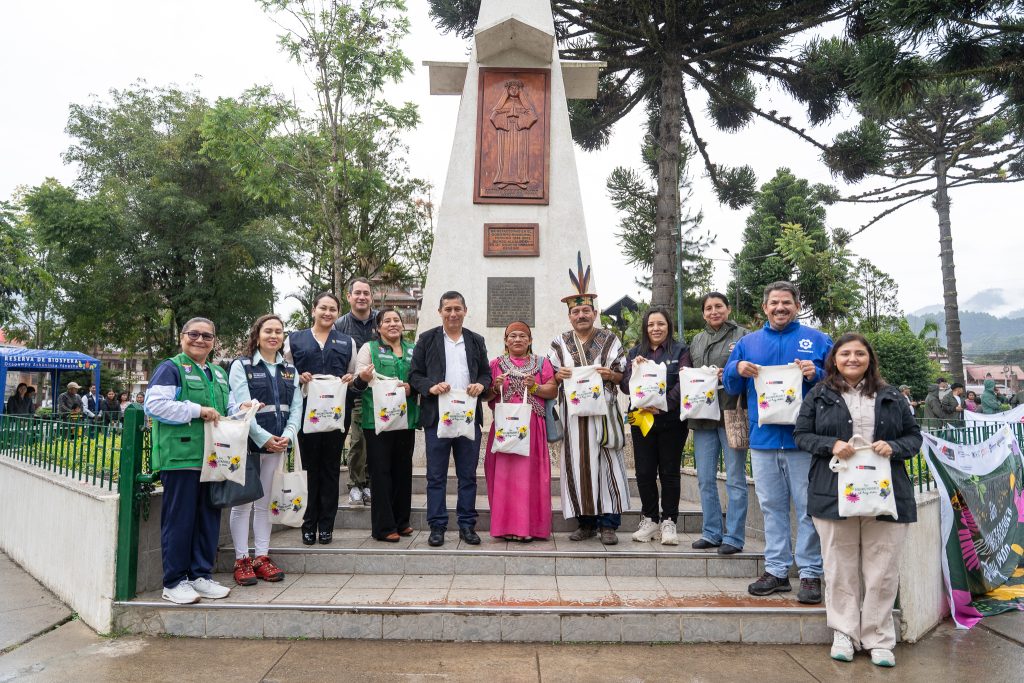
Local and indigenous authorities together with the Poli-LAC project team.
Photo: Profonanpe
Children and communities in defense of pollinators
As part of the activities prior to the main event, more than 200 primary and secondary school children were sworn in as environmental brigadistas at the “Libertador Mariscal Castilla” Integrated Educational Institution and participated in the symbolic planting of polliniferous plants, with the aim of strengthening their commitment to the protection of biodiversity.
In addition, a specialized talk on the protection of pollinating insects was previously given to the ecological brigade of the Yanachaga Chemillén National Park, in which topics on their ecological role, benefits and threats were addressed, using educational dynamics and pedagogical material.
About the project
The regional Poli-LAC project in Peru is led by the Ministry of the Environment (MINAM), with the support of German development cooperation, implemented by the Deutsche Gesellschaft für Internationale Zusammenarbeit (GIZ) GmbH, on behalf of the German Federal Ministry for the Environment, Nature Conservation, Nuclear Safety and Consumer Protection (BMUV), with funding from the International Climate Initiative (IKI), and executed in the Oxapampa - Asháninka - Yánesha Biosphere Reserve (BIOAY) by Profonanpe, Peru's environmental fund.