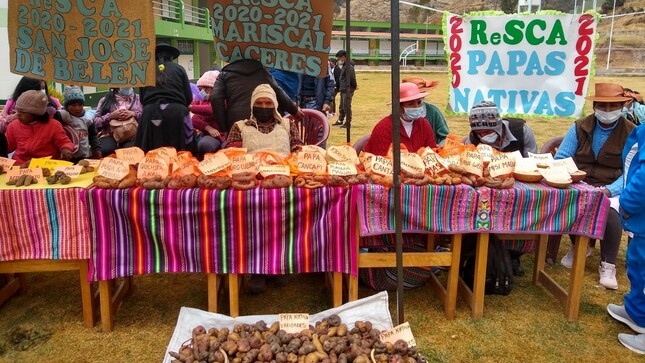
Environment Minister Rubén Ramírez participated virtually in the awards ceremony held yesterday in the district of Laria. During the event, he highlighted the work of conservationist farmers and the importance of the ReSCA mechanism.
He asserted that this mechanism aims to promote the recovery of crop diversity in at-risk areas, with traditional farming families and rural communities playing a leading role in conservation and food security. “The ReSCA promotes sustainable and efficient agriculture through coordinated efforts among various government entities,” he stated.
Likewise, within the framework of the commemoration of the 200th anniversary of Peru's independence, it recognized the families of traditional farmers from the aforementioned districts as "Farmers of the Bicentennial of Huancavelica”.
This was in recognition of their work recovering 32 endangered native varieties from six crops: 10 varieties of potato, 4 of oca, 4 of olluco, 4 of mashua, 4 of quinoa, 3 of tarwi, and 3 of maca. In return for their conservation efforts, the farmers in these rural communities received agricultural equipment such as tools (foot plows, hoes, pickaxes, irrigation hoses, backpack sprayers, wheelbarrows, and corrugated metal sheets, among other items).
The event, along with representatives of conservationist families, also included José Álvarez, Director General of Biological Diversity at Minam; the district mayor of Laria, Urbano Cuicapuza; the regional vice-governor, Guillermo Quispe; Eusebio Vásquez, president of the National Association of Organic Producers – ANPE, and the national coordinator of the GEF-Agrobiodiversity-GIPAM Project, César Sotomayor; in addition, Marleny Ramírez, from Bioversity International, was present, among others.
Remuneration for Agrobiodiversity Conservation (ReSCA)
The ReSCA promotes the conservation of agrobiodiversity and food security in Huancavelica and other Andean regions and, at the same time, promotes sustainable and efficient agriculture where the State, through Minam, Midagri, FAO, Profonanpe, the Regional Government of Huancavelica and local governments, joins its efforts, through the GEF Agrobiodiversity Project, to directly support farmers and peasant communities in that area of the country.
Fact: