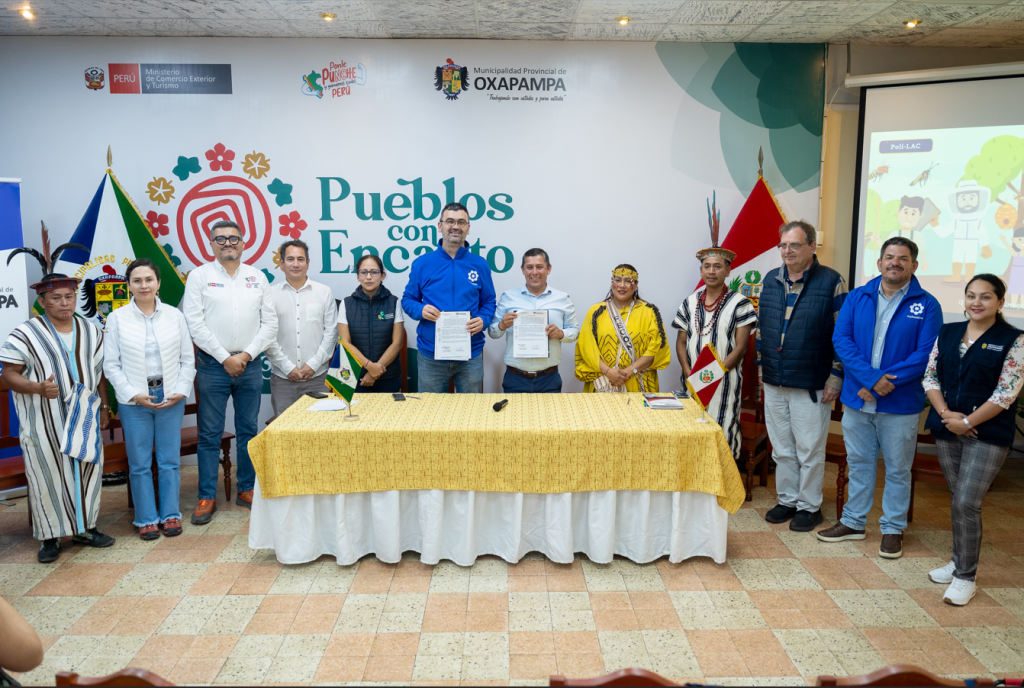
Ceremonial act in the framework of the signing of the agreement between the Provincial Municipality of
Oxapampa and Profonanpe.
Photo: Profonanpe
On Friday, August 29, an inter-institutional cooperation agreement was signed between the Provincial Municipality of Oxapampa and Profonanpe to develop joint actions within the framework of the project “Regional action for the protection of pollinating insects and pollination services in Latin America and the Caribbean” (Poli-LAC).
The purpose of the agreement is to establish a collaboration framework between the two institutions to promote the sustainable management of natural resources, strengthen environmental services and contribute to the conservation of biological diversity in the Oxapampa province.
Anton Willems, executive director of Profonanpe, stressed the importance of working together to promote the protection of these biodiversity allies: «This agreement is a starting point and we are sure that, with the work of the project, we will be able to demonstrate that together we can go further and that together we can do things better.

Anton Willems, executive director of Profonanpe and Euler Osorio, mayor of the municipality
Provincial of Oxapampa.
Photo: Profonanpe
The protocol ceremony was also attended by Andreas Gettkant, director of the regional Poli-LAC project of the German Development Cooperation - GIZ, who highlighted the relevance of this agreement for research on pollinating insects in the region: «For us, BIOAY is a very important center of biodiversity, where we can study pollinating insects. In the next three years we will see the results of the research on the importance they have for maintaining ecosystems and their contribution to productivity».
Insect pollinators such as bees, butterflies, beetles and flies play a key role in plant reproduction and food production. It is estimated that about 75 % of the world's agricultural crops depend to some extent on insect pollination.
In the case of Oxapampa, their contribution is vital for the development of emblematic crops such as coffee, cacao, avocado, passion fruit and citrus, which are an important source of income for local farming families. However, pollinator populations face serious threats due to the irresponsible use of pesticides, habitat loss and the effects of climate change.
Likewise, the protection of pollinators is fundamental for the native peoples of Oxapampa, such as the Asháninka and Yánesha, whose traditional agricultural practices and worldview maintain a close relationship with nature. The conservation of these insects not only ensures the continuity of their subsistence and exchange crops, but also preserves their cultural heritage linked to respect and care for the forest.
In this sense, Eva Gómez, representative of the Indigenous Peoples Development Management, highlighted the role of women in the protection of the forest: «From the indigenous peoples, women are the main protectors of the forest and our pollinating insects, such as native bees».
As part of the day, the director of the regional Poli-LAC project (GIZ), together with local authorities and guests, visited the insect hotel located in the Plaza de Armas of Oxapampa, a space designed to provide shelter and protection to various species of pollinators. During the visit, they also participated in a symbolic planting of polliniferous plants around the hotel, reinforcing the commitment to the conservation of local biodiversity.

Visit of authorities and guests to the insect hotel located in the Plaza de Armas of Oxapampa.
Photo: Profonanpe
In addition, the authorities visited the educational stand of the Poli-LAC project, installed in the Plaza de Armas as part of the 134th anniversary of the province, where the population was able to learn more about the importance of pollinating insects and environmentally friendly practices that contribute to their care.

Educational stand of the Poli-LAC project in Oxapampa's main square.
Photo: Profonanpe
About Poli-LAC
The Poli-LAC regional project in Peru is led by the Ministry of the Environment (MINAM), with the support of German development cooperation, implemented by the Deutsche Gesellschaft für Internationale Zusammenarbeit (GIZ) GmbH, commissioned by the German Federal Ministry for the Environment, Nature Conservation, Nuclear Safety and Consumer Protection (BMUV), with funds from the International Climate Initiative (IKI), and executed in the Oxapampa – Asháninka – Yánesha Biosphere Reserve (BIOAY) by Profonanpe, Peru's environmental fund.