The province of Oxapampa has just set an important environmental precedent in the country. The Provincial Municipality approved, in a council session, an ordinance that declares the protection of pollinators to be of public interest, with special attention to insects and native bees, also promoting friendly practices and research aimed at conserving the ecosystems of the Oxapampa-Asháninka-Yánesha Biosphere Reserve (BIOAY).
The standard recognizes the fundamental role that pollinating insects such as bees, butterflies, flies and beetles play in food security, forest conservation and agricultural production of the province's emblematic crops such as coffee, cocoa, passion fruit, citrus and avocado.
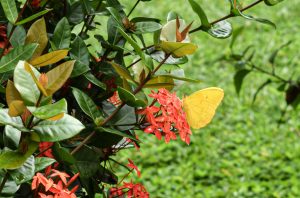
Butterfly perched on a flower, one of the most prominent groups of pollinating insects.
Currently, about 75 % of the world's crops and plants depend, to a large extent, on pollinating insects for their reproduction and food production, making them essential actors for biodiversity and human life.
In addition, the ordinance, promoted within the framework of the Poli-LAC project, officially institutionalizes the “Pollinating Insects Week”, to be celebrated every third week of May in the province, within the framework of World Bee Day. This year, the activities will take place from May 18 to 24 in various districts of Oxapampa.
Oxapampa bets on a more nature-friendly production process
The ordinance approved by the Provincial Municipality of Oxapampa seeks to promote a more sustainable development model that is compatible with biodiversity conservation.
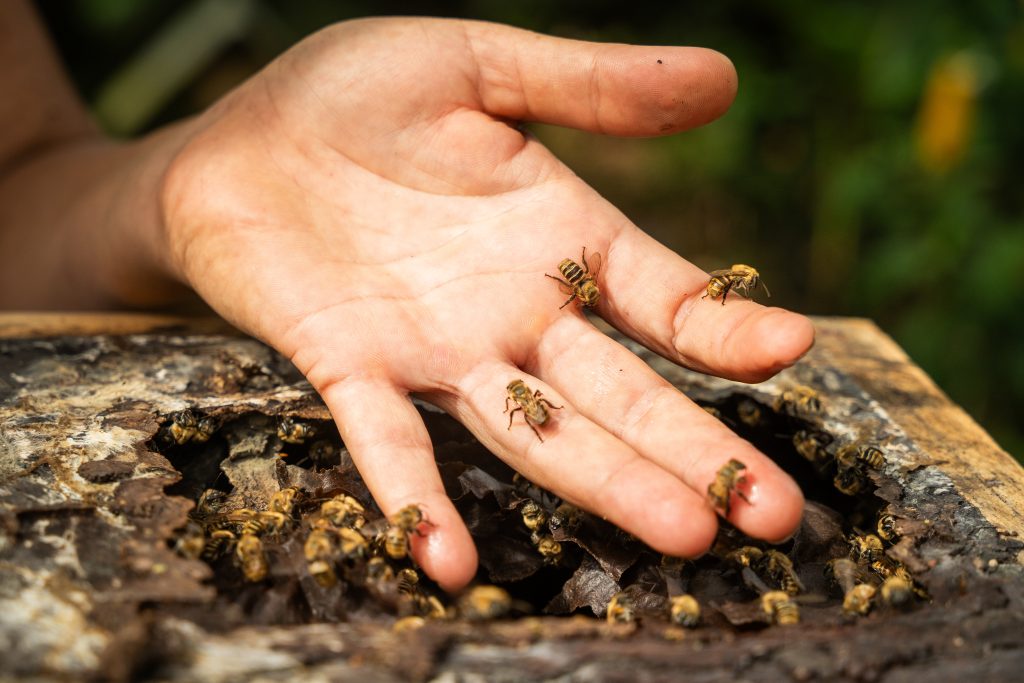
To this end, it promotes, among other actions, the promotion of pollinator-friendly practices such as encouraging the responsible management and breeding of native bees; promoting the responsible use of agrochemicals and good agricultural practices; encouraging the establishment and maintenance of agroforestry crops; promoting the planting and reforestation with polliniferous and honey plants in urban and rural areas; and promoting community and formal environmental education, as well as citizen science as a strategy to promote the monitoring and protection of native stingless bees and pollinating insects.
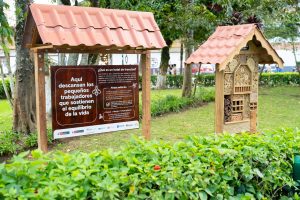
“Insect Hotel”, a nesting place for pollinators, located in the Plaza de Armas of Oxapampa.
The ordinance also prohibits the planting of the African Tulip, an invasive species whose nectar is lethal to native bees.
A model that integrates science and ancestral knowledge
The ordinance also promotes the recognition of the traditional knowledge of the Asháninka, Yánesha, Andean and Austro-German peoples, integrating their ancestral knowledge into scientific and academic research. In this way, a participatory process is guaranteed and the results of the research are returned to the communities in accessible and culturally relevant formats.
The standard also encourages scientific research on biodiversity and pollination, promoting partnerships with universities, environmental organizations, public institutions and local stakeholders.
With this initiative, Oxapampa strengthens its commitment to biocultural conservation and positions itself as a national reference in the protection of pollinators and the promotion of sustainable development models.
About Poli-LAC
In Peru, the regional project “Protection of pollinating insects in Latin America and the Caribbean (Poli-LAC)” is led by the Ministry of the Environment, in partnership with the Pollinator Technical Group, the Ministry of Agrarian Development and Irrigation and Profonanpe, with the support of German development cooperation, implemented by GIZ, on behalf of the International Climate Initiative (IKI) of the Federal Government of Germany.